
Russian
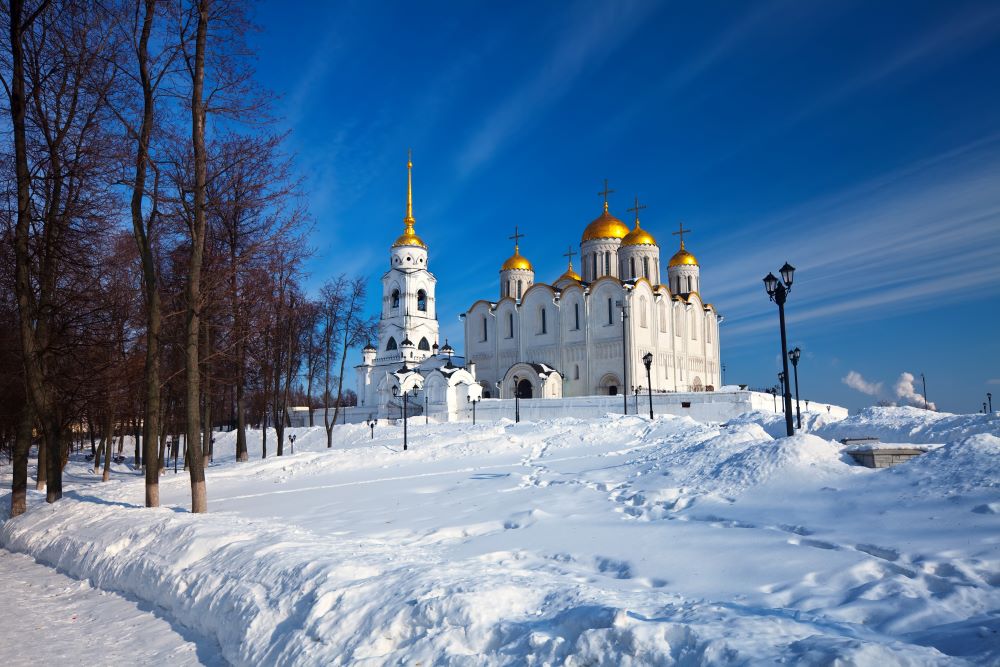
Spoken by over 250 million people, Russian ranks among the top ten most spoken languages globally: it is the official language of the Russian Federation and also holds official status in Belarus, Kazakhstan, and Kyrgyzstan. It is widely spoken and understood in Ukraine, the Baltic states, Central Asia, the Caucasus, and Eastern Europe, and remains a common language of communication across much of the former Soviet Union. Beyond this region, Russian-speaking communities exist all over the world, from Germany and Israel to the United States and Canada. Russian is also one of the six official languages of the United Nations, underlining its global political and diplomatic importance.
Learning Russian opens the door to an extraordinary cultural legacy. It is the language of Tolstoy, Dostoevsky, Chekhov, and Pushkin — writers whose works have shaped world literature. Through Russian language, learners gain a deeper understanding of a region whose history has profoundly influenced global politics, science, and culture.
Russian modules for 2026/27 are offered at beginner, intermediate and advanced levels.
Only credit-bearing modules are offered in 2026/27, i.e., modules counting towards a student's undergraduate degree programme, where a programme allows students to take a credit-bearing language elective. Extracurricular, non-credit bearing language modules for students, staff or members of the public will not be offered in 2026/27.
Russian modules are year-long (over two semesters), they have 88 taught classroom hours and are worth 30 credits. Check your level or take a diagnostic test.
All language modules are taught in-person, on the Mile End campus.
The modules offered in 2026-27 are listed below. Times and rooms will be added as the information becomes available.
Please note that in some cases there may be changes to days/times or venue prior to the start of teaching. Any changes will be updated on this website.
Introductory Russian
Three weekly sessions (2+2+1 hour), over two semesters.
- Module Code: RUS4203 (30 credits)
- For: Complete beginners. Target exit level: A2.
- Schedule: 22 weeks (21st September 2026 – 16th April 2027)
- Hours: 88 classroom hours plus 212 hours independent study
- Class times: TBC
Russian II Intensive
Three weekly sessions (2+2+1 hour), over two semesters.
- Module Code: RUS5202: Russian II Intensive (30 credits)
- For: Learners with level A2. Target exit level: B1.
- Schedule: 22 weeks (21st September 2026 – 16th April 2027)
- Hours: 88 classroom hours plus 212 hours independent study
- Class times: TBC
Russian I
Two weekly sessions of 2 hours each, over two semesters.
- Module Code: RUS4201: Russian I (30 credits)
- For: Learners with A-Level in Russian or CEFR level A2+. Target exit level: B1+.
- Schedule: 22 weeks (21st September 2026 – 16th April 2027)
- Hours: 88 classroom hours plus 212 hours independent study
- Class times: TBC
Russian II
Two weekly sessions of 2 hours each, over two semesters.
- Module Code: RUS5202: Russian II (30 credits)
- For: Learners who have taken RUS4201 (Russian I) OR RUS5202 (Russian II Intensive) or have an equivalent language level (CEFR level B1+). Target exit level: B2.
- Schedule: 22 weeks (21st September 2026 – 16th April 2027)
- Hours: 88 classroom hours plus 212 hours independent study
- Class times: TBC
Russian III
Two weekly sessions of 2 hours each, over two semesters.
- Module Code: HSP6200: Russian III (30 credits)
- For: Learners who have taken HSP5200 (Russian II) or have an equivalent language level (CEFR level B2+). Target exit level: C1/C1+.
- Schedule: 22 weeks (21st September 2026 – 16th April 2027)
- Hours: 88 classroom hours plus 212 hours independent study
- Class times: TBC