
How is the study contributing to assessing the impact of the sugar tax?
|
What we know |
What we don’t know |
|
The sugar tax has helped to reduce the number of children needing hospital treatment for tooth extractions caused by tooth decay. |
It is unclear whether the tax has helped reduce the gap in tooth decay rates between social groups, ethnic backgrounds and living areas. |
The study is looking to answer:
-
How does the sugar tax impact the distribution of severe tooth decay across:
- Social groups
- Ethnic backgrounds
- Living areas?
-
What are the economic benefits associated with sugar tax?
How is the study being conducted?
The study is using existing hospital admission data for tooth extractions in children under 18 years old in England.
By comparing data before, during, and after the implementation of the sugar tax, the study will analyse any changes and differences in hospital admissions across socioeconomic groups, ethnicities and living areas.
The second part of the project will calculate public savings resulting from the sugar tax, as well as the financial benefits for the health system.
What has the study found?
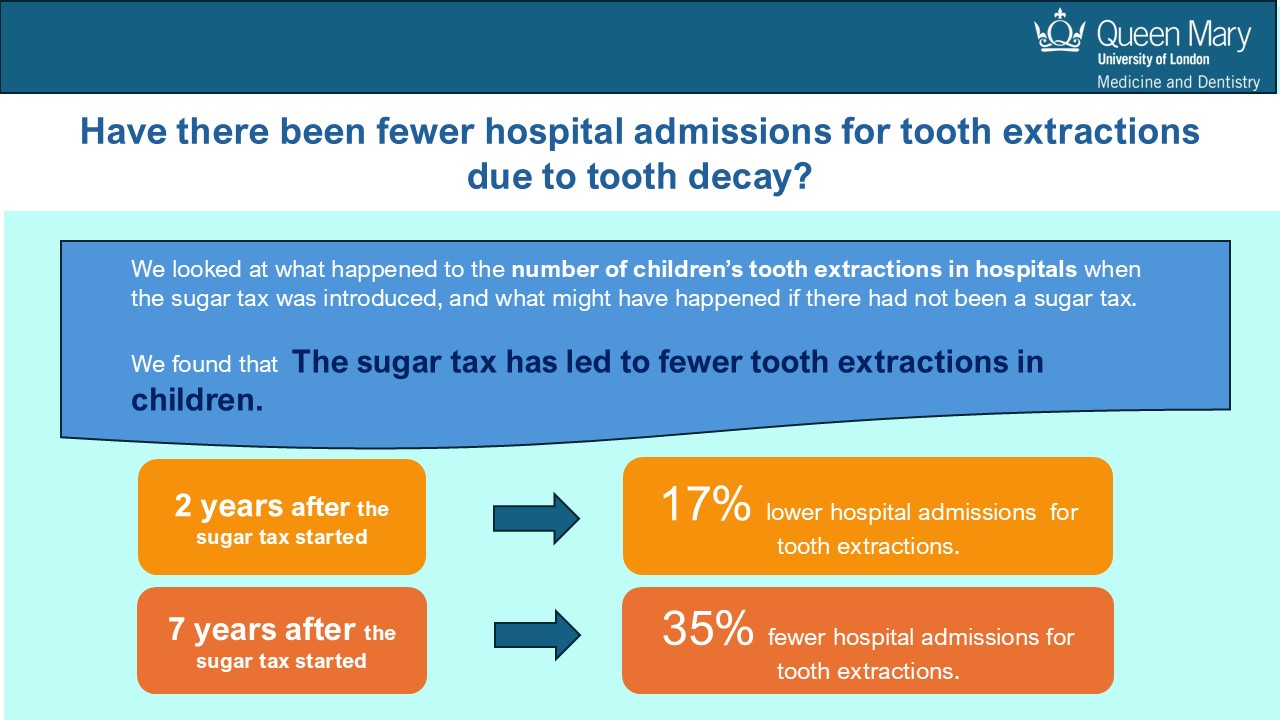
The Soft Drinks Industry Levy (sugar tax) began in England in 2018. Since then, fewer children have had to go to hospitals to have decayed teeth removed. However, an important question remained: has the sugar tax benefited children from the most deprived areas and ethnic groups equally?
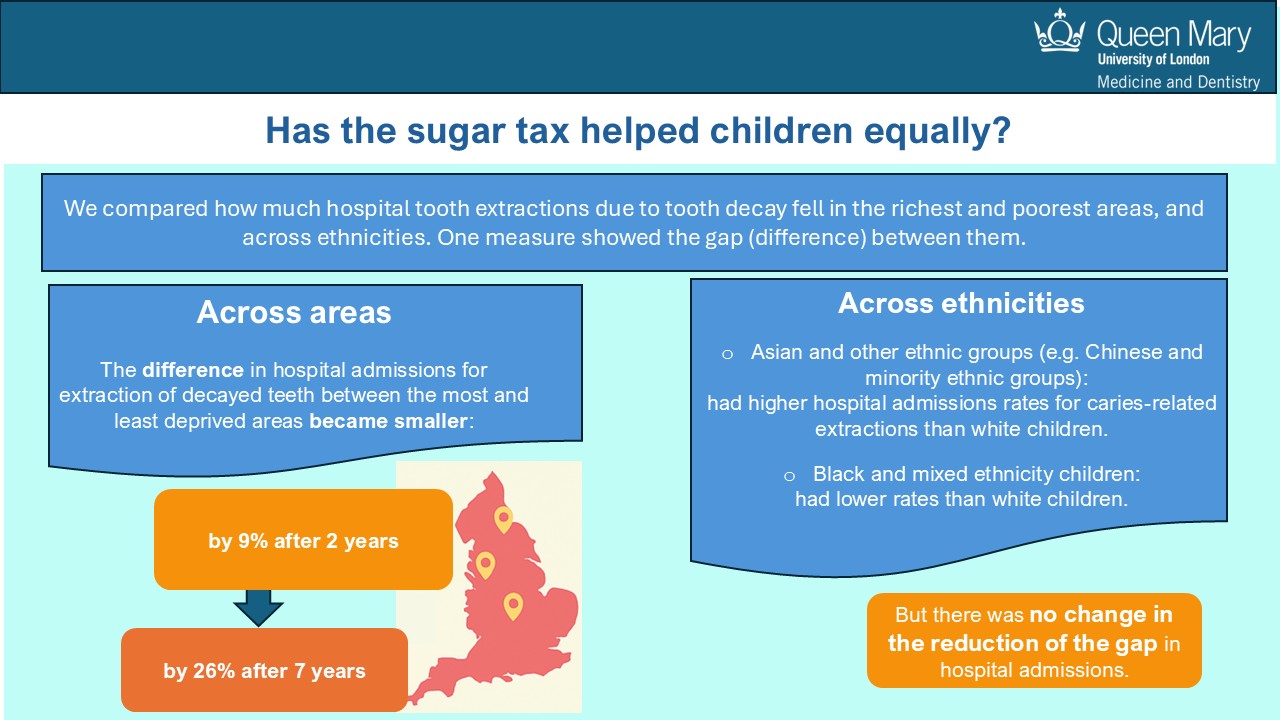
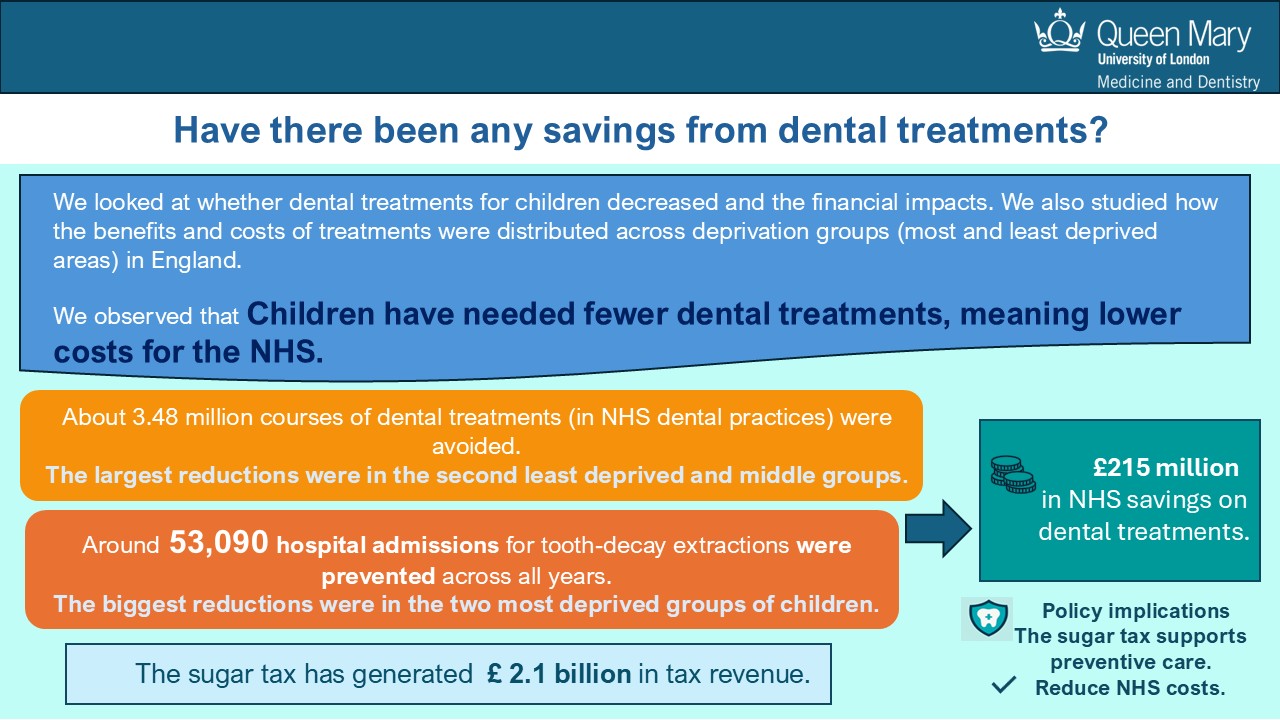
We explored data on hospital admissions for extractions of decayed teeth in children aged 0 to 17 in NHS England hospitals. We focused on three key areas, presented in the infographics below. A summary of the findings is also available to download as a poster Poster-Sugar tax

What do these results mean?
- The sugar tax has led to fewer hospital admissions for tooth extractions due to tooth decay.
- The gap in hospital admissions between richer and poorer areas also became smaller.
- There were no changes in the differences in hospital admissions for tooth extractions between ethnic groups.
- Reductions in hospital admissions began after the sugar tax was implemented in April 2018, although changes in products and consumption may have started earlier, after the tax was announced in March 2016.
- Reductions in dental activity have resulted in NHS cost savings of around £215 million.
These findings should be interpreted with caution. Long-term trend may have been influenced by COVID-19 lockdowns, which reduced hospital admissions. In addition, the study did not measure children’s sugar consumption or the number of cavities, which may also affect the results.
You can read the full summary of results Summary of findings A Bengali translation is available Translation
Click below to read the published articles from this research:
https://doi.org/10.1016/j.jdent.2026.106511
https://journals.sagepub.com/doi/10.1177/00220345251408835