
Health, Environment and Technology
The Health, Environment and Technology (HEaT) research theme works across conventional sub-disciplinary boundaries to consider questions of power, justice and inequality in vital systems and biomedical geographies.
A shared priority of the theme is to produce rigorous, relevant and conceptually informed research with a global reach that recognises the uneven geographies of human and more-than-human health which characterise the contemporary moment. We are united in pursuing research and teaching which strives for reparative approaches to inform global and domestic health and environmental policy.
Our research is driven by the following sets of concerns:
1) We understand healthcare systems as complex networks, comprising elements including institutions, ethical considerations, marketing strategies, clinical trials, and the labour of scientists, healthcare professionals and researchers.
2) We understand the provision of healthcare to be a biopolitical endeavour that shapes and moulds particular forms of healthy and unhealthy subjectivity and one that has long been the subject of critical geographical enquiry.
3) We recognise that biomedicine co-exists with plural epistemes of health and vitality
4) We are invested in tracing the production and differential material exposures to environments which constrain vitality and doing research alongside activists working to refuse toxic conditions
If you are interested in collaborative events, speaking in our seminars, or in pursuing doctoral research within the HEaT cluster, please get in touch with Liz Storer, who convenes this research group (e.storer@qmul.ac.uk).
HEaT Members
Please click on the profiles below to learn more.
Tim Brown [biopolitics; risk; food; mobilities; infrastructure]
Tim is Professor of Global Health Geography at QMUL. His research broadly explores the productive and transformative potential of public health discourses. Under the broad rubric of critical public health geographies the contexts of his research range from: HIV/AIDS and the social construction of risk; ‘urban healtheries’ in nineteenth century London; public health interventions targeting breast cancer and most recently food insecurity and infrastructure in Southern Africa. He is co-author of Health Geographies: A Critical Introduction (Wiley Blackwell 2018) and co-editor of A Companion to Health and Medical Geography (Wiley Blackwell 2010) and Bodies Across Borders (Ashgate 2015).
Sydney Calkin [sexual and reproductive health; LGBTQ+ health; abortion; pharmaceuticals]
Sydney is a Reader in Geography and the Primary Investigator of the UKRI Horizon Guarantee grant Pharmaceutical Geographies of Self-managed Sexual Health. Her research explores self-managed health and informal health networks, primarily on medication abortion, but with broader interests in HIV and trans health. She is the author of Abortion Pills Go Global: Reproductive Freedom Across Borders (University of California Press 2023).
Kerry Holden [science and technology; knowledge; institutions; portals]
Kerry is a Senior Lecturer in Human Geography. Her research explores knowledge cultures and practices transnationally. She focuses on examining the managerial, administrative and professional dimensions of science and technology, analysing the significance of political and moral economies that support how science travels and becomes politically viable.
Liz Storer [distress; toxicity; hostile environments; ethnographic and creative methodologies]
Liz is a Lecturer in Health Geography and convenes the HEAT cluster. Her research broadly explores the enduring processes through which coloniality shapes human and ecological health, and has been largely been undertaken in the postcolonial contexts of Uganda and the UK.
Stephen Taylor [global health; biomedicine; mental health]
Stephen is a Senior Lecturer in Human Geography. His research explores the political and spatial dimensions of biomedicine and global health, examining how clinical trials, global health initiatives and philanthropic interventions intersect with histories of inequality, exploitation, and contested forms of care.
PostDoctoral Researchers
Ed Kiely [feminist and trans methodologies, urban studies and political economy].
Ed’s research interrogates the relationships between healthcare systems, social inequalities and state violence. Their research asks: how can we reconcile the benefits of organised healthcare with the harms it perpetrates, particularly against marginalised groups? Can these systems be redirected towards social justice, or do we need to imagine something else entirely? Ed is currently pursuing a Leverhulme Trust Early Career Fellowship which explores the geographies of involuntary psychiatric detention (‘sectioning’) in London and Amsterdam.
Alvaro Martinez Lacabe [PrEP; HIV prevention; histories of health; sexual dissidence]
Álvaro is a postdoctoral researcher within the Pharmaceutical Geographies of Self-Managed Sexual Health project. His research examines the emergence of informal networks facilitating access to PrEP, the impact of informal PrEP practices on the development of emerging models of sexual health care, and the transnational circulation of activist knowledge in the field of HIV prevention.
Tate Morgan [health sociology; gender; STS]
Tate is a postdoctoral researcher within the ‘Pharmaceutical Geographies of Self-Managed Sexual Health’, where he focuses on 'DIY' hormone use among trans people. His research interests operate at the intersections of health sociology, gender and trans studies, and feminist science and technology studies.
Doctoral Researchers
Shruti Arora [feminism; activism; reproductive justice; abortion]
Shruti is a queer-feminist activist and PhD researcher from India. Her research on reproductive politics in the context of rising authoritarianism in postcolonial India, working across the intersecting areas feminist legal geography, reproductive rights and justice, and health technologies. Previously, Shruti has worked with feminist and human rights organisations. She co-founded the Young Activist Network for Abortion Advocacy (YANAA) in 2018.
Ella Berny [reproductive justice; feminist/creative methodologies; abortion storytelling]
Ella is a PhD researcher focusing on abortion discourse through different sites of abortion storytelling in England. Her project interrogates the limits and possibilities of ‘speaking out’ in dispelling abortion stigma and imagining abortion otherwise. Ella is also a Media Manager at Amnesty International UK, specialising in gender justice, reproductive justice and protest work.
Rita Sharma Pandeya [disaster; environment; Nepal]
Rita is a doctoral researcher investigating natural disasters and disease outbreaks in the context of Nepal. Her research aims to learn more about the social and health effects of natural disasters on poor and marginalised people.
Melisa Tatiana Slep [sexual and reproductive health and rights; feminist movements and organisations; Latin America; gender mainstreaming]
Melisa is a doctoral researcher focusing on access to abortion in subnational Argentina after decriminalisation. The objective is to enquire on the role that feminism(s) at the subnational level in contemporary Argentina have in a post-legalisation scenario, following activists’ abortion strategies and modes of engagement and their role in public policy implementation of abortion services against diverse local contexts, actors and networks.
Charlotte Stevens [mobilities; metabolic illness; science and technology studies]
Charlotte is a doctoral researcher who researches the lived experiences of UK residents who have self-funded metabolic and bariatric surgery in Türkiye, which has become known as a global surgical hub. The project seeks to articulate the imaginations, vulnerabilities, and logics enfolded within this emergent carescape.
Spotlight: Current Research Projects
Pharmaceutical Geographies of Self-managed Sexual Health
Pharmaceutical Geographies of Self-Managed Sexual Health explores how people self-manage their sexual, reproductive and gender-related healthcare needs outside of formal medical settings. It asks how, why, and by what means people self-manage their health needs using pharmaceuticals (and information) they obtain online and use through informal channels. It focuses on three categories of medical products and the communities that surround them: Pre-Exposure Prophylaxis (PrEP) for HIV prevention, abortion pills (mifepristone and misoprostol), gender affirming hormones (DIY HRT) on self-managed sexual, reproductive, and gender health.

Photo by Maksim Goncharenok, reproduced under Creative Commons license:
The project currently has three staff: Sydney Calkin (PI) leads work on abortion pills; Alvaro Martinez Lacabe leads work on HIV PrEP and Tate Morgan leads work on DIY hormone use. The first phase of work focuses on qualitative interviews and observation of therapeutic communities and pharmaceutical buyers’ clubs. Later stages of the project will involve chemical testing of pharmaceuticals obtained online, in collaboration with therapeutic communities and treatment activists.
Planetary Portals
Through the Planetary Portals collective, Kerry Holden conducts archival research on extractive industries in South Africa to think through the colonial afterlives that continue to shape contemporary life, value systems and equity across geographies that stretch from east London to Southern Africa. She explores the organisation of bodies in mining communities, and how the value of life and death was organised along racist lines that set in motion the necropolitics of the Apartheid regime that remain in the toxic environments and limited access to healthcare affecting South Africa’s Black and indigenous communities. Kerry’s collaboration with Environmental Humanities South (EHS) at the University of Cape Town builds on the Portals project to address the toxic legacies of colonialism in developing reparative epistemologies for more sustainable and healthy environments.
A website which presents this research is available here.
Housing Distress in Postcolonial Britain
In the UK, where houses have become assets, rising rates of eviction, as well as the privatisation of social housing, deepen and generate forms of bodily and mental distress. Such distress has generally been made legible through epidemiological pathways or public health surveys, which understand the house through a suite of factors linked to clinical outcomes. Missed here are: geographic and anthropological understandings of house not simply as dwelling but as home; aetiologies of affliction which elide neat categorisation; and crucially, the logics of a propertied system which drives distress.
Liz Storer’s collaborative research with Nikita Simpson (SOAS) and Suad Duale (SOAS) has developed an ethnographically informed approach to ‘Listen to Housing Distress’. Writing from struggles in inner city Birmingham (2022-5), we have argued that housing distress is driven by cumulative harms generated not just through substandard dwellings, but movement between private and social tenancies, and through endless bureaucratic categorisations including via digital portals. Rather than becoming a safety net, social housing has become a source of intense stress and illness.
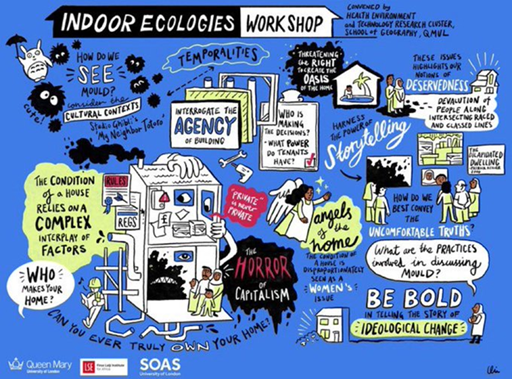
Image from QMUL Indoor Ecologies Workshop 2024 @olliemannart:
A central finding of this research was that complaints were silenced or redirected to blame women for their own housing conditions. Developing this key finding, we are developing a new project which scrutinises how health complaints move through state domains. We ask of the life of complaints at the ‘meso’ scale and how politically potent bodily claims are (un)seen through biomedical, legal, and environmental evidentiary regimes. To date this research has been funded by LSE, SOAS and ESRC. A short film of this research is available to watch here.
Food Cultures: Mobility, Security, Health
Tim Brown’s interest in ‘food cultures’, especially at the intersection with mobility, security and health, is built upon longstanding interdisciplinary research into the social and environmental dimensions of undernutrition in Zimbabwe. The main concern here is the unevenness in people’s access to food and how this is shaped, at least in part, by differing kinds of mobilities and to consider what this means for food and nutrition security.
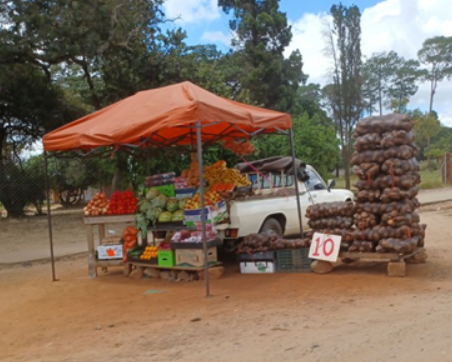
Street vendor, Harare. 2024 (Tim Brown, personal image)
Tim’s research in this area is undertaken in collaboration with colleagues in the Department of Geography and Environmental Science at Queen Mary, as well academic social scientists, civil society organisations, and other research organisations in Zimbabwe. The scope of the research, which was initially funded through an Arts and Humanities Research Council (AHRC), UK, partnership development grant awarded in 2019, has recently been extended to include a focus on postcolonial infrastructure repair (in collaboration with Dr Joseph Tinarwo, Great Zimbabwe University), as well as upon migrant remittances. The latter involves partnering with the MiFOOD Network to deliver an ambitious multi-country programme of research that will provide insights into the role that remittances may play in promoting food and nutrition security for vulnerable communities faced with environmental change brought about by the climate crisis.
More details of Tim’s research, including a list of publications, can be found on his personal website.
HEaT in the media
Kiely, E. 2025, Short Cuts: University finances. London Review of Books
Kiely, E. 2025, Unfair Judgments: Lethal cuts at the DWP. London Review of Books
Calkin, S. 2024, What’s in a Pill? The Baffler
Calkin, S. 2024, Supreme Court is Considering Nationwide Restrictions on Most Common Abortion Method: Medication abortion. Ms. Magazine
HEaT in Policy
Humphris, R., Storer, E. et al. 2025, Addressing Housing Distress to Improve Inner City Well-Being. QMUL Policy Brief
Storer, E., Simpson, N., Duale, S., Gaskell, I. 2024, Listening to Housing Distress: A methodology for understanding housing and mental health in context. SOAS University of London
Calkin, S., Berny, E. 2022, Submission to the consultation by the Irish Government on the Review of the operation of the Health (Regulation of Termination of Pregnancy) Act 2018. Submission drawn from a co-authored article: Calkin, S., Berny, E. 2021, Legal and Non-Legal Barriers to Abortion in Ireland and the United Kingdom. Medicine Access@ Point of Care
Recent HEaT Publications
2025
Brown, T., Datta, K., Achieng, C., Kabongo, J., Zulu, J.M., Bwakura-Dangarembizi, M., Prendergast, A. 2025, Caring for Children with SAM: Intersectional stories of shame, blame and stigmatisation in Zimbabwe, Zambia and Kenya. Global Public Health
Kiely, E. 2025, Austerity Optimism: Affective geographies of institutional coordination. Environment & Planning C: Politics and Space
Martinez-Lacabe, A. 2025, Beyond the Neoliberal Label: A historical perspective on sexual actors and responsibility in HIV prevention in England (1986–2023). Health: An Interdisciplinary Journal for the Social Study of Health, Illness and Medicine
Storer, E., Simpson, N., Duale, S., Hubbard, E. 2025, ‘Fighting Him’: Following Housing Distress in the Hostile Environment. Social Science and Medicine
Simpson, N., Storer, E., Duale, S. 2025, Hostile Environments: Mould, race and blame amidst Birmingham’s housing crisis. Environment & Planning D: Society and Space
2024
Brown, T., Datta, K., Fernando, S., Kabongo, J., Bwakura-Dangarembizi, M., Prendergast, A. 2024, Convalescing from SAM: The pitfalls and possibilities of caring for vulnerable children in Harare’s high-density neighbourhoods. Social Science and Medicine
Calkin, S. 2024,. ‘It’s Not Mifepristone, But It’s Not Poison’: Finding fakes in Poland’s abortion underground. Cambridge Journal of Anthropology
Datta, K., Brown, T., Mutambasere, T. 2024, ‘Road runners’ and Fanta: Intersectional cultural food in/security among Zimbabwean migrants living in UK cities. Global Food Security
Holden, K., Harsh, M. 2024, On Pipelines, Readiness and Annotative Labour: Political geographies of AI and data infrastructures in Africa. Political Geography
Kiely, E., Millet, N., Barron, A., Kreukels, B., Doyle, D.M. 2024, Unequal Geographies of Gender-Affirming Care: A comparative typology of trans-specific healthcare systems across Europe. Social Science & Medicine
Kiely, E. 2024, Entrepreneurship as Conditionality: New geographies of work(fare) in mental health services under austerity. Geoforum
Wuerth, M., Storer, E., Simpson, N., Sarafian, I., Duale, S. 2024, Securitized Trust: On the multiple guises of the UK policy agenda during the Covid-19 pandemic. Critical Policy Studies