
A Week at the United Nations Headquarters
Over reading week, final-year senior status student Renite Gosal attended the Seventieth Session of the Commission on the Status of Women, representing Canada in a delegation with Young Diplomats of Canada.
/filters:format(webp)/prod01/channel_119/school-of-law/media/law/undergraduate/blogs/renite-primary-image.jpg)
In an informal reflection on mentoring women in politics, a Brazilian MP stated “Nós, mulheres globalmente, somos mais fortes quando nos encontramos, como riachos e rios encontram o oceano.” We, women globally, are stronger when we meet, like how streams and rivers meet the ocean. Attending the Seventieth Session of the Commission on the Status of Women was like a meeting at the intersection of various bodies of water.
As a research coordinator for the delegation, I co-wrote a policy brief addressing femicide in Canada, drawing on CEDAW and an inter-American framework via Canada’s recent signing of the Convention of Belém do Pará. In Canada, 2024 data indicate that one woman or girl is killed approximately every two days, with half of these killings perpetrated by an intimate partner. This bleak figure is nearly identical in the United Kingdom.
Our policy brief:
Establish One-Stop Crisis Centres
Canada should establish one-stop crisis centres integrating medical assessment and treatment with forensic examination.
Establish Specialized GBV Courts
Canada should establish specialized courts dedicated to gender-based violence cases, combining criminal and civil jurisdiction.
Mandate Disaggregated Data Collection
Canada should mandate disaggregated data collection across all justice touchpoints.
Indigenous-Led Community Responses
Canada should adopt Indigenous-led community responses, recognizing that formal justice systems have systematically failed Indigenous women.
The Week Ahead
Throughout the week, my delegation advocated four key recommendations to reduce femicide. We met with various senators, members of parliament, ambassadors, academics, and activists, as well as the United Nations Special Rapporteur on violence against women and girls, its causes and consequences.
My legal studies at Queen Mary informed my advocacy through courses such as International Human Rights Law (LAW6034) and Public International Law (LAW6032). I have learned overarching frameworks for international law and critically analysed numerous states’ infringements and shortcomings in upholding the rule of law.
Practical experiences such as my involvement in the SPITE for Schools Project in the QMLAC, led me to attend a session at CSW70 on Tech-Facilitated Gender-Based Violence. There, I heard from a UK minister on Ofcom’s power to remove posts within 48 hours, and from Australia’s eSafety Commissioner, the world’s first digital government regulatory agency, which has taken bold steps to address tech-facilitated abuse. This has provided me with the foundation for having critical discussions with policymakers to create tangible improvements in women’s lives and to better understand safeguarding against democratic backsliding.
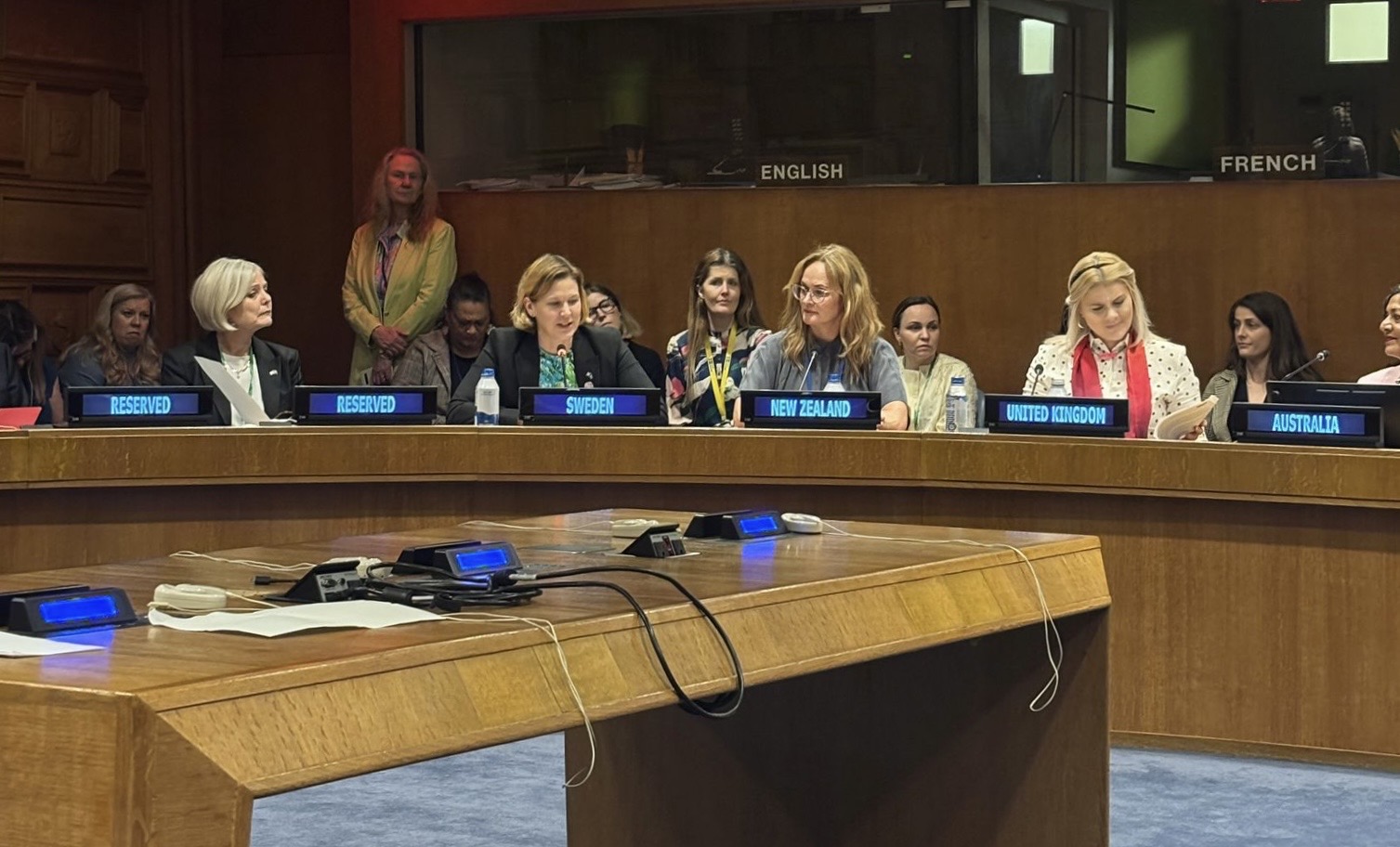
The most profound takeaway from the week was the power of multi-disciplinary collaboration. It is not possible to advance women’s equality without working across legal, economic, cultural, and political lines. For instance, Equimundo, a civil society organisation addressing harmful masculinities, hosted a talk about re-envisioning healthy masculinities. Tech-facilitated Gender Based Violence frequently involves children as perpetrators, demonstrating a need for upstream solutions, not the criminalisation of boys as a default solution. Femicide is often framed as a violence against women problem, not also as a symptom of failing masculinities, erosion of the rule of law, and war.
From a law and economics perspective, the World Bank Group identified that, in 2026, none of the 190 economies evaluated, including Canada and the United Kingdom, grants women equal economic opportunities. Globally, women enjoy only two-thirds of the legal rights of men.
Kofi Annan asked in 2012, ‘What are our responsibilities in a world that is simultaneously coming together and coming apart?’ Today, as conflict deepens, economies falter, and violence against women and girls continues to rise, his question feels more urgent than ever. As the global rule of law fragments amid surging uncertainty and instability, I think of the women and girls who will bear the brunt of this heightened vulnerability.
It is our responsibility as delegates representing our nations, individuals representing our values, and above all as humans. I am taking responsibility by honing my skills as a law student to create change, showing up in civil society, and supporting other young women to receive education and access to these spaces. I returned to London with renewed hope in the small, collective wins of feminist practice in a world that feels fragmented yet still strives toward collective empowerment and an end to violence.
What responsibility are you taking in this world that’s simultaneously coming together and apart?
Written by Renite Gosal.