Landmark trial on whole blood transfusion published in NEJM
The results of a landmark clinical trial on the use of whole blood transfusions in pre-hospital trauma care have been published in the New England Journal of Medicine.
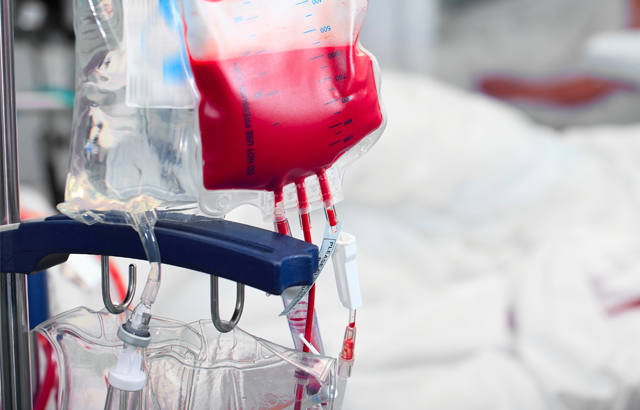
Bag of blood for transfusion
Major trauma kills more than 5,400 people every year in the UK (NHS, 2024). Early blood transfusion at the scene is known to improve survival, but until now, there has been limited large-scale evidence comparing different transfusion strategies in the pre-hospital setting in the UK.
The SWiFT trial, which began in December 2022 and recruited 942 patients over two years, aimed to compare the current standard of care – transfusing red blood cells and plasma as separate components– to transfusing whole blood as it comes from a donor (ie red blood cells, plasma and platelets in a single bag). The use of whole blood has attracted interest as it offers potential practical advantages in the pre-hospital environment, including simpler storage and transport, reduced kit weight for clinical teams and faster administration at scene.
This trial, sponsored by NHS Blood and Transplant (NHSBT) and co-led by Professor Laura Green, Professor of Haemostasis and Transfusion Medicine at Queen Mary and Associate Medical Director for Research and Development at NHSBT, analysed 616 eligible trauma patients with 314 receiving whole blood and 302 receiving standard care. The study found that:
- the primary outcome (death or massive transfusion within 24 hours) occurred in 48.7% of the whole blood group and 47.7% of the standard care group.
- there was no statistically significant difference between the two approaches.
- mortality at all time points and rates of massive transfusion were similar between groups.
- safety outcomes were comparable.
In participants with life-threatening haemorrhage, pre-hospital transfusion of two units of whole blood was not superior to standard care in reducing death or the need for massive transfusion within 24 hours.
These new findings provide critical evidence to inform future clinical guidance, procurement decisions and research priorities across the NHS and the pre-hospital emergency medicine sector.
Professor Laura Green, co-chief investigator for SWiFT, Professor of Haemostasis and Transfusion Medicine at Queen Mary, Consultant in Haemostasis and Transfusion Medicine at Barts Health NHS Trust, and Associate Medical Director for Research and Development at NHSBT, said: “The contribution of everyone involved in the trial – from air ambulance pilots, blood service, our blood donors and supporters to the trial team and military medics – will help guide the future care of people experiencing traumatic, life-threatening bleeds.
“The trial did not show a benefit from whole blood but in providing that answer it will help us improve trauma care. We are thankful to the participating air ambulance organisations and Defence Medical Services for collaborating with us to drive innovation and research for seriously ill patients.”
Lindsay Boswell, Interim CEO of Air Ambulances UK said: “The publication of the SWiFT trial in the New England Journal of Medicine marks an important moment for pre-hospital emergency medicine in the UK. Although whole blood was not shown to improve outcomes compared to current practice, having clear, high-quality evidence allows the sector to make informed clinical decisions. Air ambulance charities are committed to continual improvement in trauma care, and this trial reflects that shared commitment to evidence-led innovation.”
This work builds on Queen Mary’s expertise as in trauma care. It is home to the world-leading Centre for Trauma Sciences, where research spans the entire patient journey — from immediate post-injury care through to rehabilitation outcomes. The University’s location and close partnership with Barts Health NHS Trust places it at the forefront of global trauma research. This includes many of its researchers working with The Royal London Hospital, one of four major trauma centres in the London Trauma System which serves 10 million people each year, embedding the University in the largest trauma system in the world. This unique partnership enables cutting-edge research that is directly saving thousands of lives.
Related items
 News story:
Kidney disease is growing in Africa: big new study casts light on genetic risk factors
News story:
Kidney disease is growing in Africa: big new study casts light on genetic risk factors
10 April 2026
News story:
Largest genomic study of kidney function in Africa reveals new genetic risk factors
25 March 2026