
Queen Mary’s Night of Science and Engineering celebrates innovation, partnership, and impact
Yesterday (Tuesday 17 March) Queen Mary University of London’s Faculty of Science and Engineering welcomed partners, collaborators, and invited guests to its annual Night of Science and Engineering.
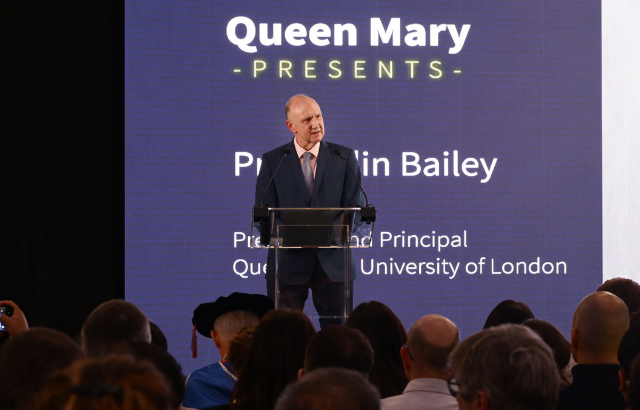
Prof Colin Bailey welcomes guests to the Night of Science and Engineering 2026 event
The event, now in its fourth year, showcases the world leading research, innovation, and partnership carried out across the Faculty. This year’s event, themed ‘Local Impact - Global Reach', explored how the Faculty of Science and Engineering’s work is delivering positive impact locally and across the globe, in line with the Government's Industry Strategy.
It brought leaders from industry, government, charities, and academia, together with senior figures from across Queen Mary. Guests engaged with a vibrant programme of speakers and interactive stands, each demonstrating transformative breakthroughs taking place across science and engineering at Queen Mary.
Speaking on the event, Professor Colin Bailey, CBE, President and Principal at Queen Mary said: “Our Night of Science and Engineering demonstrates the best of Queen Mary — excellence, ambition, collaboration and a powerful sense of purpose. This year’s event showed how our work and partnerships are shaping a future that is more sustainable, connected, and equitable and which is delivering positive impact for our local communities and people across the globe.”
Professor Wen Wang, Vice-Principal and Executive Dean for the Faculty of Science and Engineering added: “The Night of Science and Engineering stands as a testament to Queen Mary’s commitment to advancing knowledge, inspiring innovation, and shaping a better world. The breakthroughs displayed during the event illustrate what happens when brilliant researchers collaborate across disciplines and sectors, and show our Faculty and University’s commitment to translating discovery into real-world impact, which partnerships are central to achieving.”
Throughout the evening, guests explored interactive exhibits and were offered hands-on insights into research spanning energy solutions, robotics, biodiversity, advanced materials, and next-generation digital technologies, demonstrating how Queen Mary researchers are addressing critical global challenges.
The event also clearly showcased how this research is supporting the Government’s Industrial Strategy, which highlights how science, research, and innovation are central to the UK's economic resilience and global competitiveness – a principle that resonates strongly at Queen Mary.
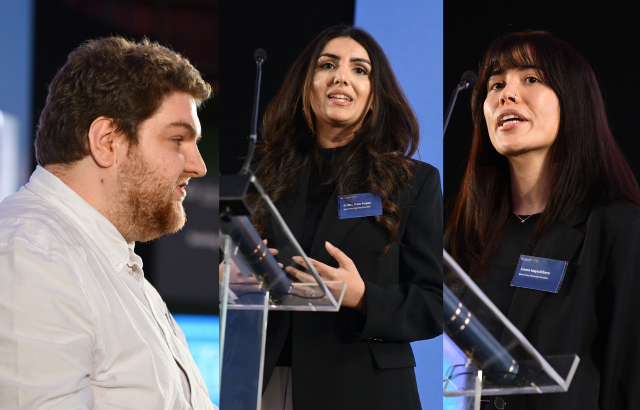
Three outstanding PhD researchers demonstrated the breadth and impact of the Faculty’s educational environment at the event. Emma Hayashibara shared her research developing an inclusive mental health assessment tool for neurodivergent young people. Daniel Gill highlighted his interdisciplinary work with roboticists and psychologists to understand interactive motion patterns, helping to inform more inclusive technology design. Dr Zara Arain Saqlan presented her machine‑learning research predicting preterm birth as part of the Air Pollution and Pregnancy Clinical Trial, showcasing the Faculty’s strength in applying advanced methods to major clinical challenges.
Celebrating excellence
A highlight of this year’s event was the recognition of Professor Yongyuth Yuthavong and Professor David Owens with honorary degrees from Queen Mary.
Professor Yongyuth Yuthavong was awarded an Doctor of Sciences in recognition of his lifelong dedication to advancing science for societal benefit, as well as his deep connection to Queen Mary. Professor David Owens was also awarded a Doctor of Sciences for his contributions to the UK telecommunications industry and engineering profession.
Professor Yongyuth Yuthavong is a distinguished Thai scientist whose career spans scientific discovery, national policy leadership, and international impact. A chemistry alumnus of Queen Mary College, one of Queen Mary’s founding institutions, Professor Yongyuth Yuthavong subsequently studied at the University of Oxford, later establishing a prolific research career at Mahidol University, where he became Professor of Biochemistry. His leadership in Thailand’s scientific landscape includes serving as Director, National Centre for Genetic Engineering and Biotechnology (1985–1989), First President, National Science and Technology Development Agency (1991–1998), Minister of Science and Technology (2006–2008) and Deputy Prime Minister of Thailand (2014–2015).
Professor Yuthavong’s numerous honours include the Outstanding Scientist of Thailand Award, the Nikkei Asia Prize for Science, Technology and Innovation, and the Dushdi Mala Medal. During his time in the UK, he was also part of a senior delegation from King Mongkut’s University of Technology Thonburi, Thailand hosted by the Faculty, which aim to develop a new strategic partnership, which could launch joint engineering programmes in AI, electronics and robotics, while expanding research collaboration between the two institutions."
Professor David Owens is a distinguished telecommunications engineer whose career spans more than four decades of innovation and leadership. He began his career as an apprentice telecommunications technician in the British Army’s Royal Electrical and Mechanical Engineers, later contributing to secure communications and early cellular networks, before progressing into senior roles at Vodafone and BT Cellnet (O2).
Professor Owens holds an MSc in Mobile and Satellite Communication Systems and completed his PhD at the University of Surrey in 2023, following more than a decade of parttime research alongside his industry work. A Fellow of the Institution of Engineering and Technology, an Associate Fellow of the Women’s Engineering Society, and a Chartered Engineer, Professor Owens continues to bridge research and real-world application, shaping the future of mobile and connectivity technologies.
Among other projects, he has overseen the development of 5G-enabled drone systems for search-and-rescue teams, equipping emergency services with airborne mobile-mast capability to operate in areas without traditional network coverage and his work has been recognised through several professional accolades, including the 2025 Mobile Industry Award for Innovation.
Related items
 News story:
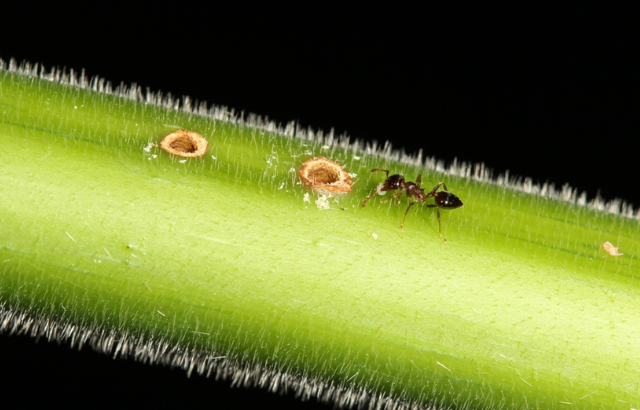
Wasps move in on ant–plant partnership, disrupting a 10‑million‑year mutualism
News story:
Wasps move in on ant–plant partnership, disrupting a 10‑million‑year mutualism
15 April 2026
 News story:
Queen Mary PhD Students Champion Neurodivergent Inclusion at Night of Science and Engineering
News story:
Queen Mary PhD Students Champion Neurodivergent Inclusion at Night of Science and Engineering
19 March 2026