
Queen Mary early-career researchers awarded prestigious European Research Council Starting Grants
Four early-career researchers from Queen Mary University of London have received major European Research Council (ERC) Starting Grants to support their brilliant research ideas.
478 early-career researchers across Europe have been selected in the 2025 call to receive the €761 million funding. Each researcher will receive a €1.5 million grant for over five years to lead their research team to pursue ambitious research with the potential for major scientific breakthroughs. The competition attracted nearly 4,000 applications, with only 12% of proposals selected for funding.
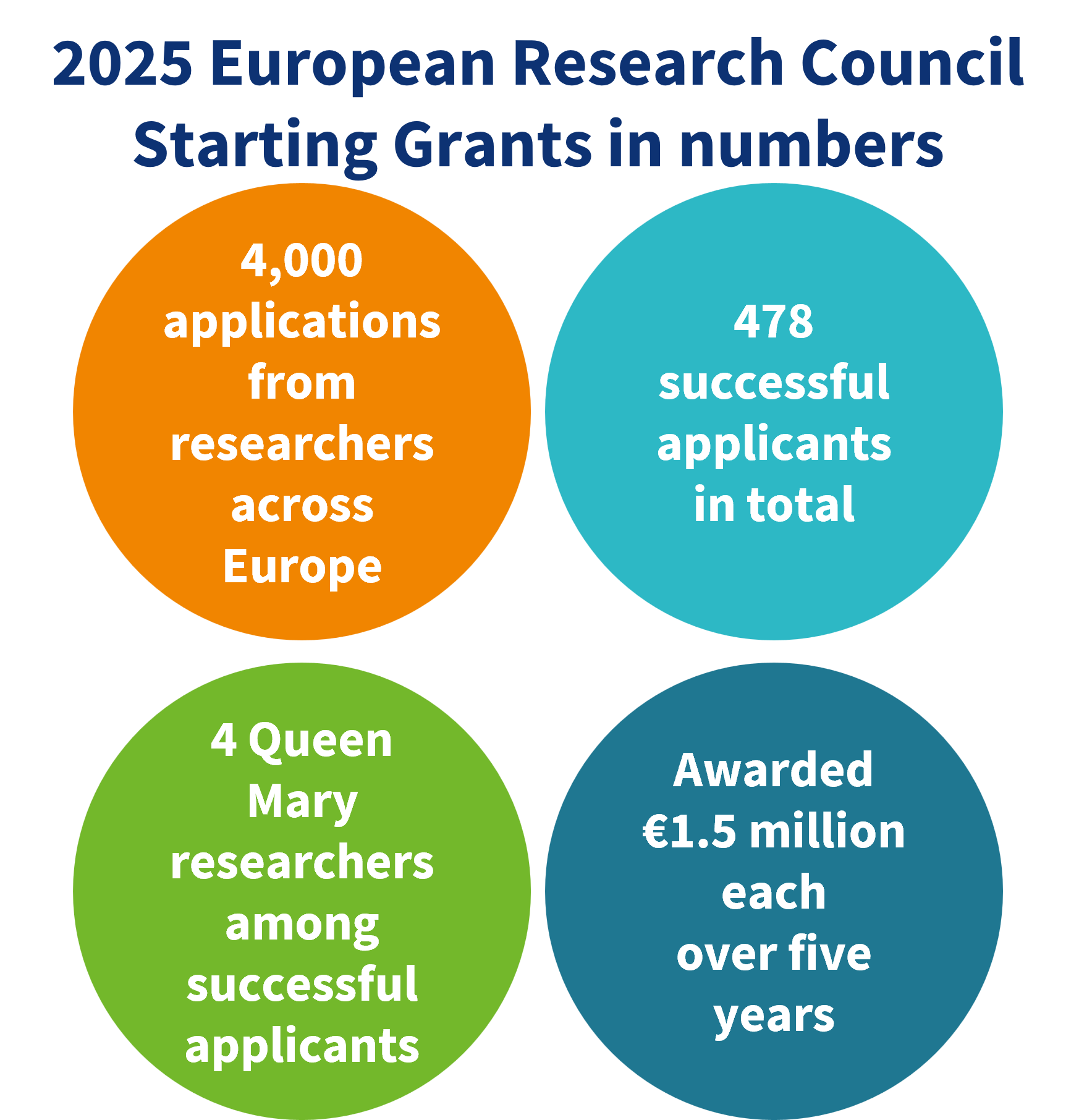
Professor Andrew Livingston, Vice-Principal (Research and Innovation) at Queen Mary said: “European Research Council Starting Grants are hugely competitive, awarded to the brightest minds across Europe. I am thrilled that four of our early career researchers have been awarded these prestigious grants. The researchers sit across all of our Faculties, demonstrating the diversity and breadth of research excellence at Queen Mary, and our commitment to supporting the development of the next generation of research leaders."
Dr Kieran Bates, Lecturer in Microbiome Science, Faculty of Medicine and Dentistry – Drivers and consequences of host microbiome control (FROGMICRO) 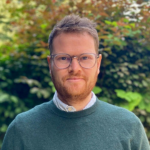 Dr Bates will explore how microbial communities assemble in animal hosts, laying the groundwork for future targeted microtherapies.
The microbiome plays a central role in health, including defending against pathogens. Using the ERC Starting Grant, Kieran will explore how hosts control their microscopic ecosystems to promote beneficial rather than harmful microbes. This research programme will advance our fundamental understanding of how complex microbial communities assemble in animal hosts, laying the groundwork for targeted microbiome therapies.
On receiving the award, Dr Kieran Bates said: "I am thrilled to receive an ERC Starting Grant and am immensely grateful for the support from colleagues. This funding will enable my lab to pursue exciting research to unravel the complexities of host microbiome assembly.”
Dr Cristina Gualdani, Senior Lecturer in Economics, Faculty of Humanities and Social Sciences – Robust econometrics of games in IO (REGIO)

Dr Gualdani will develop econometric methods to better understand how firms behave when they compete against each other across a wide range of real-world industrial organisation settings.
The REGIO project develops advanced econometric methods to better understand how firms behave when they compete with each other across a wide range of real-world industrial organisation settings. These methods fill important gaps left by existing techniques and offer a structured way to move beyond less credible assumptions about firm behavior and market conditions, allowing researchers to draw more robust conclusions. Their effectiveness is shown through practical applications that support fair competition, strengthen consumer protection, and provide clearer insights into inequality and its distributional impacts.
On receiving the award, Dr Cristina Gualdani, said: "I am honoured to receive this grant and deeply grateful to my colleagues at Queen Mary for their encouragement and support. Through REGIO, I will develop new quantitative methods to study how firms compete and how markets function in practice. This will allow us to challenge unrealistic assumptions, generate more reliable evidence, and shed light on how competition affects consumers, fairness and inequality.”
Dr Rachel Humphris, Senior Lecturer in Sociology and Politics, Faculty of Humanities and Social Sciences – Digital welfare borders: the effects of artificial intelligence in migrants’ access to welfare (DigiWeB)
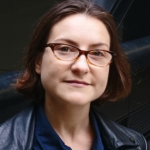
Dr Humphris will explore how Artificial Intelligence (AI) is reshaping welfare systems and migration management across Europe.
DigiWeB is a groundbreaking study on how Artificial Intelligence (AI) is reshaping welfare systems and migration management across Europe. As governments turn to AI to decide who can access social protection, these technologies risk embedding bias and creating “digital borders” that restrict support for marginalised migrants. The project brings together data science and social science to investigate how welfare algorithms operate in practice in the UK, Netherlands, and Sweden, while also foregrounding the experiences of those directly affected. Its findings will guide policymakers toward fairer uses of welfare-AI and raise vital questions about the future of welfare and migration in a digital age.
Dr Rachel Humphris said: “AI is rapidly changing how governments make decisions about welfare and migration, but we don’t yet fully understand the consequences. DigiWeB will uncover how these technologies shape people’s everyday lives and create new forms of digital borders. By bringing together data science and ethnography, my goal is to provide evidence that can help ensure welfare systems are both fairer and more accountable.”
Dr Marc Fernández Yagüe, Lecturer (Assistant Professor) in Chemistry, Faculty of Science and Engineering – Deconstructing adaptive piezoelectric responses in pathological and healthy microenvironments (DAPHNE)

Dr Fernández-Yagüe will explore how living tissues generate and respond to tiny electrical signals when they are injured or become diseased.
DAPHNE will explore how living tissues generate and respond to tiny electrical signals when they are injured or become diseased. These natural “bioelectric signals” are often overlooked, yet they can strongly influence how cells communicate and whether tissues heal or scar. By developing new laboratory models that capture these complex physical cues, the team aim to predict and ultimately reprogram the progression of tissue fibrosis – a devastating condition where tissues become stiff and lose function. This research could open new paths for therapies that restore healthy repair mechanisms.
On receiving the award, Dr Marc A. Fernández-Yagüe said: “I am thrilled to receive an ERC Starting Grant to pursue this research. By decoding how cells and tissues use electrical signals to adapt to injury, we hope to uncover new ways to treat fibrotic diseases, which remain one of the greatest unmet medical challenges. I am especially proud to lead this work at Queen Mary, where our collaborative environment is ideal for pioneering research at the interface of materials chemistry, biology, and medicine.”