
The TurtleTurtle Photo-Identification Game: engaging with marine science and conservation
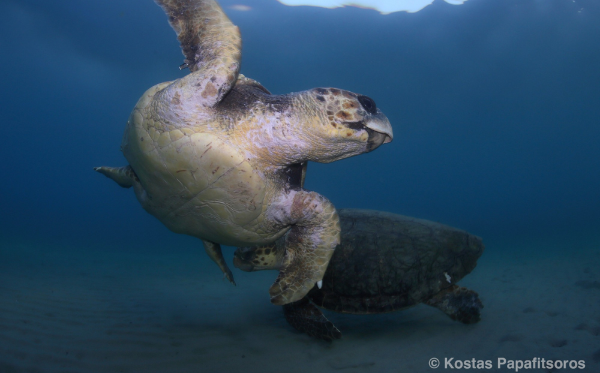
Find out more about a first of its kind sea turtle photo-ID game, making marine science and conservation knowledge accessible to everyone
- Faculty: Faculty of Science and Engineering
- School: School of Mathematical Sciences
- Format: Digital game
- Key themes: public engagement; sea turtle conservation
Please can you give us an overview of your project and its aims?
Sea turtles are flagship species and fascinating animals to study, yet they are globally threatened to varying degrees by pressures including interaction with fisheries, climate change, coastal development, pollution, vessel strikes, among others. Dr Papafitsoros has been conducting research for many years with the loggerhead population of Zakynthos Island, Greece, one of the most important sea turtle populations in the Mediterranean in close collaboration with ARCHELON, the Sea Turtle Protection Society of Greece. The primary research tool used is individual sea turtle photo-identification (photo-ID) that is, the identification of individuals from images taken in different encounters based on their unique external morphological patterns (head scales). Dr Papafitsoros has been leveraging on this technique to study many aspects of sea turtle ecology and conservation (inferring survival rates, compiling life histories, studying behaviour). With various collaborators, he is also active on the development of state-of-the-art AI-based automated sea turtle photo-ID algorithms. His work places particular emphasis on quantifying tourist pressure, threats and boat-related injuries of the individual turtles of Zakynthos, a persistent problem on the island, which hosts more than one million tourists yearly.
Could you tell us more about the game you created?
With the help of a 2024 QMUL Centre for Public Engagement Large Grant, Dr Papafitsoros created the first of its kind sea turtle photo-ID game, TurtleTurtle (https://www.turtleturtle.fun). This is an interactive, educational (and fun!) web and mobile friendly application where users are trying to match images of the same sea turtle individuals. After each successful match, the story of the turtle is revealed (e.g. residency patterns, behaviour, any injuries it has had etc) as well as several other short trivia about sea turtle biology, conservation and AI aspects of photo-ID. Getting to know the life details of individual turtles via this way, can sensitise people, in particular the local stakeholders in Zakynthos about the threats of the turtles there. In general, the game is turning scientific data into an interactive experience, making marine science and conservation knowledge accessible to everyone.
The game has many difficulty levels which challenge even the world experts in sea turtle photo-ID. Thus, it can also play the role of a training tool for citizen scientists and training conservationists helping them to become familiar and test their skills on sea turtle photo-ID.
/filters:format(webp)/prod01/channel_262/queen-mary-university-of-london/media/qmul/publicengagement/case-studies/Turtle-Turtle-2.png)
The TurtleTurtle photo-ID game
What kind of impact did your project have?
The TurtleTurtle project was lauched in August 2025 via various social media channels and received an overwhelming response from the international sea turtle community. More than 500 visitors have played the game ever since.
One of the main objectives of the TurtleTurtle project is to leverage on its developed infrastructure in order to help other organisations that use wildlife photo-ID in their scientific activities, to create their own versions of the game with their own images and enhance their awareness and educational activities. Towards that, Dr Papafitsoros partnered with TurtleWatch Egypt 2.0 (TWE) (https://turtlewatchegypt.net) a citizen science initiative dedicated to monitoring and conserving marine turtle in the Egyptian Red Sea since 2011. Sea turtles in the Egyptian Red Sea face threats from habitat loss, tourism and limited awareness. Dr Papafitsoros together with the organisation’s Project Manager, Micol Montagna, successfully applied for an Innovation Grant awarded by the International Sea Turtle Society to develop TurtleTurtle-Red Sea (https://red-sea.turtleturtle.fun), a new version of the game which now draws data from TWE’s sea turtle photo-database. This new version was launched in January 2026 and is already part of TWE’s educational and promotional activities for tourists, dive centres and local communities.
/filters:format(webp)/prod01/channel_262/queen-mary-university-of-london/media/qmul/publicengagement/case-studies/Untitled-design-(4).png)
Left: The new version of the game TurtleTurtle-Red Sea. Right: Presentation of the game from TWE’s volunteer Doreen Hofmann (Coraya Divers team) at the Boot Show, Düsseldorf, Germany, January 2026. Photograph by Verena Spennhoff.
Sustainable development goals
The success of marine conservation, i.e. the protection of “Life Under Water”, is strongly dependent on education and awareness. The TurtleTurtle games bring exactly that to everyone’s phones. They raise awareness and foster empathy by helping tourists, students, and local communities recognise turtle individuality, understand their ecology, and learn about the threats they face - encouraging positive behavior change among visitors and operators. Furthermore, it strengthens citizen science participation by engaging a wider audience in photo-ID efforts, transforming passive observers into active contributors to conservation.
SDGs supported:
- SDG 14: Life Below Water
Find out more about the SDGs at Queen Mary University of London.
This project was supported by a Centre for Public Engagement Large Grant. Find out more about the Large Grants.