
From Classroom to Community: ‘Engineering Meets History’ at The Brunel Museum
Hear about the experience of three undergraduate Mechanical Engineering students helping to bring engineering history to life at The Brunel Museum
/filters:format(webp)/prod01/channel_262/queen-mary-university-of-london/media/qmul/publicengagement/SEMS-Brunel-project-showcase.jpg)
Project Leads: Dr. Rehan Shah (School of Engineering and Materials Science) and Dr. Jack Hayes (Brunel Museum)
Student Interns: Ms. Malmi Mahagamage, Ms. Meherun Soud, and Mr. Yash Vaghela (School of Engineering and Materials Science)
Have you ever wondered what lies under the Thames River and the history it carries?
"We did and were curious to delve deeper into this- and so the three of us, Malmi Mahagamage, Meherun Soud, and Yash Vaghela, all current undergraduate Mechanical Engineering students from QMUL undertook a project, funded by the Centre for Public Engagement, in collaboration with our academic supervisor Dr. Rehan Shah and Dr. Jack Hayes from the Brunel Museum.
The Thames tunnel remains a landmark in engineering history, as since its inception, it continues to play a vital role, now used partly by the London Overground Windrush Line to transport thousands of people around London daily. Our task was to create resources that could be a help to inform visitors to the museum about the engineering principles and methodologies used to construct the tunnel, while highlighting the historical significance of 19th century technologies.
To begin, we held initial meetings with Dr. Jack Hayes, the Collections Access Coordinator at the Brunel Museum. In these meetings, we discussed and reviewed a collection of images and carefully chose those most appropriate to form the basis of our resources. Following this, we each conducted independent research into our chosen topics, crafting concise 100-word texts to clearly convey both the technical and historical context. These drafts went through several rounds of discussion and refinement over the weeks, ensuring a strong balance between accessibility and accuracy.
From there, the selected images were adapted into a poster format alongside the texts written. Together, we crafted 6 visually engaging and informative posters, which we first presented internally to museum staff on 30th July, receiving encouraging feedback.
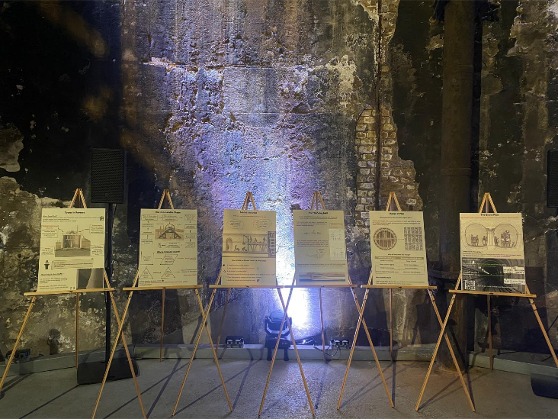
Shortly afterwards, they were further introduced to the public on the 3rd of August. Although the anticipated family audience was less prominent at the event, the feedback received was overwhelmingly positive. These talks greatly improved our communication abilities, giving us valuable experience in presenting our technical ideas in a way that resonated with a non-technical audience.
Overall, this project provided us insight into the deep and cultured history of the Thames tunnel and the opportunity to share that knowledge with others. Beyond the goal of the project, the experience strengthened our teamwork, communication and project management skills, while the independent research enhanced our technical and analytical abilities, aiding us in future endeavours.
In closing, our journey exploring the history and engineering behind the Thames Tunnel has been both educational and inspiring. Through this project we not only gained insight into the pioneering spirit of 19th century engineering but also developed skills in collaboration, communication, and research that will continue to shape our paths as Mechanical Engineering students. However, most importantly, we were able to contribute to keeping this remarkable piece of history alive for future generations to explore and appreciate."
Dr. Shah and the students also disseminated their work-in-progress on this project through a poster presentation at the QMUL Festival of Education in June 2025.
This project was supported by a CPE Small Grant. Find out more about the Small Grants scheme.