
'Squashing bugs not snakes’: co-creating an AI-motivated Python toolkit to develop engineering students’ programming proficiency
Muhie Al Haimus, Silvia Santafe and Dr Rehan Shah share a student-staff co-creation initiative which developed a comprehensive Python Toolkit designed to provide equitable access to essential programming skills.
/filters:format(webp)/prod01/channel_311/queen-mary-academy/media/qm-academy/innovation-and-learning-/AdobeStock_175199101.jpeg)
The introduction of artificial intelligence (AI) has revolutionised engineering, making programming skills increasingly more important than ever for students 1,2, by significantly boosting their confidence and equipping them to succeed within multidisciplinary STEM programmes. Despite this, engineering students often struggle with coding concepts due to limited early exposure in their prior years of study 3.
Feedback from past engineering students at QMUL highlighted that the existing Python teaching materials were devoid of depth and clear conceptual explanations, further compounded by the fact that a large proportion of incoming undergraduates had little to no prior programming experience.
Motivated by this, our student-staff co-creation initiative promotes inclusive education by providing all learners with equitable access to essential programming skills. In partnership with the module organiser Dr Shah, a team of current students developed a comprehensive Python Toolkit comprising:
- A Common Errors Handbook focusing on the coding mistakes students most frequently make.
- A Practice Questions and Solutions guide to test and strengthen essential programming knowledge.
- Interactive video tutorials demonstrating the fundamentals of progamming through a step-by-step scaffolding approach.
Designed to support students at different levels of programming experience, we piloted the toolkit within two applied mathematics modules in SEMS in the 2024/25 academic year. Students provided dedicated feedback through QMPlus surveys, garnering over 340 responses, to help improve and gauge the impact of the resources.
The feedback revealed that over 75% of students did not have much familiarity with Python citing that they had less than 10 hours of programming with 49.5% of respondents having no prior programming experience at all before coming to university; reinforcing the need for this set of resources. We also acquired constructive comments to refine subsequent versions of the toolkit.
Notable student feedback comments:
“It was useful to have the basics of programming laid out clearly and concisely in the toolkit. When solving Python problems, I refer to the toolkit to rectify a lot of the common mistakes I tend to make as a novice.”
“Having a toolkit dedicated to specific libraries such as NumPy, Matplotlib and Pandas”
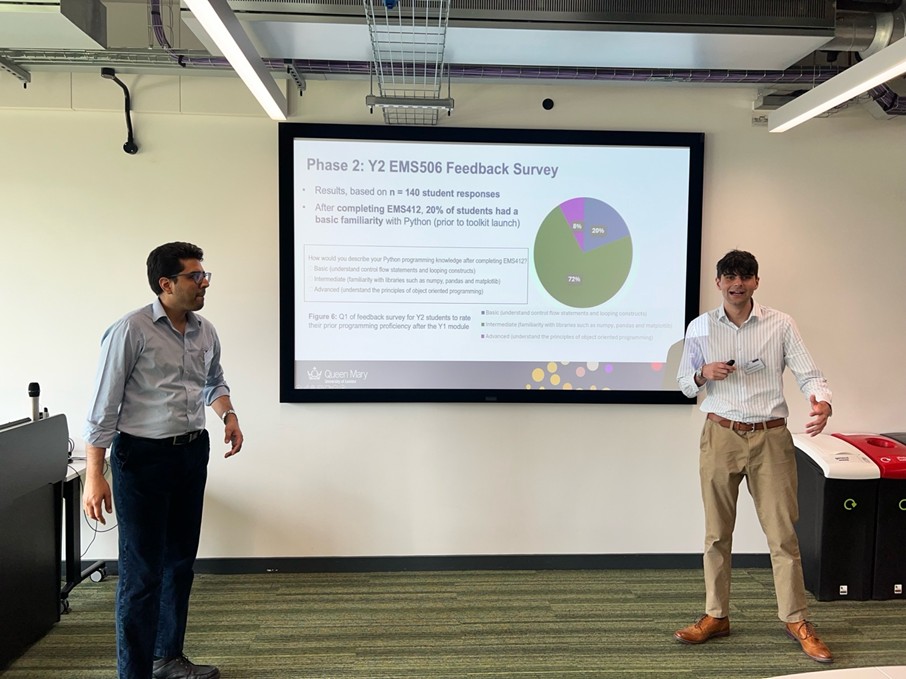
The image shows Dr Shah and student co-creator Muhie Al Haimus presenting their work at the UK&I Engineering Education Research Network hosted by the University of Manchester in July 2025.
The student co-creators also gained invaluable experiences and transferable skills through disseminating this work through presentations, posters and papers at internal seminars and national conferences. Notable instances include a published conference proceedings paper for the UK&I Engineering Education Research Network conference (July 2025), a ‘Best Undergraduate Poster’ award for the SEMS Industrial Liaison Forum showcase (Feb 2025) and an invited keynote panel session for the QMUL Festival of Education (June 2025).
Despite the proliferated use of AI to perform basic programming tasks, there is still immense value in students learning key, foundational concepts in programming. Our project highlighted that students prefer resources in a combination of media formats, both written and video based. We are enhancing our resources by producing a tailored machine learning ‘cheat sheet’ for specific Python libraries, in response to student feedback. We also aim to embed our toolkit within postgraduate engineering modules, which features several students from non-programming backgrounds and conversion courses, seeking to refresh their foundational coding skills. In this way, we hope to inspire other STEM educators to adopt similar co-creation initiatives to develop toolkit resources targeted to particularly challenging topics across related disciplines.
References
1. L. Malmi and A. Johri, “A selective review of computing education research,” English, in International Handbook of Engineering Education Research, A. Johri, Ed. United Kingdom: Routledge, 2023, pp. 573–593.
2. D. Gürdür Broo, O. Kaynak, and S. M. Sait, “Rethinking engineering education at the age of industry 5.0,” Journal of Industrial Information Integration, vol. 25, p. 100311, 2022.
3. Y.-J. Lee and R. O. Davis, ‘Assessing the Impact of Prior Coding and Artificial Intelligence Learning on Non-Computing Majors’ Perception of AI in a University Context’, Information, vol. 16, no. 4, 2025.
4. M. Al Haimus, Y. Vaghela, I. Sivagnanamoorthy, R. Shah, UK and Ireland Engineering Education Research Network Annual Symposium Proceedings, 2025, pp. 292-301 [Online]. Available: https://doi.org/10.71535/f5dfe8de-1b80-4192-8573-54d934996dec
5. M. Al Haimus, S. Santafe, Y. Vaghela, I. Sivagnanamoorthy, R. Shah, ‘Squashing bugs not snakes’: co-creating a Python toolkit to develop students’ programming proficiency’, 2025 [Online]. Available: https://www.sems.qmul.ac.uk/staff/r.shah/research/impact/
About the authors
Mr Muhie Al Haimus
https://muhie.github.io/muhie-me/about/
Ms Silvia Santafe
Dr Rehan Shah, Lecturer in Mathematics and Engineering Education
https://www.sems.qmul.ac.uk/staff/r.shah/
School of Engineering and Materials Science