
Trade Mark Practice in Action: Advising Real-Life Clients
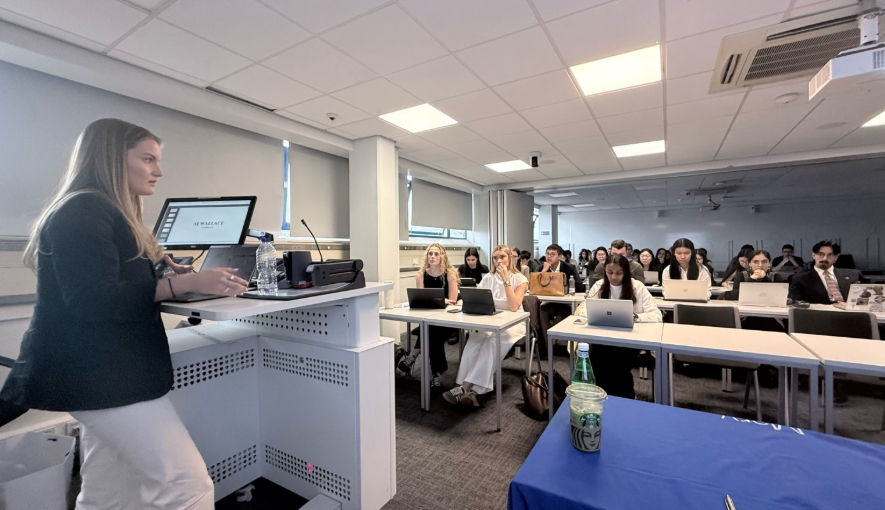

Graduate attributes forms part of the LLB Intellectual Property: Trade Mark Law module within the School of Law. As part of our assessment, students are required to work in groups to interview real-life clients in order to gather the relevant factual and legal information. During this process, students are supported and supervised by practising trade mark attorneys from the Chartered Institute of Trade Mark Attorneys and leading international law firms.
Responding to a need
This has been designed to reduce the use of generative Artificial Intelligence (gen AI) in students’ assessment outputs. Unlike the previous coursework-based assessment, this new method of assessment is less vulnerable to gen AI misuse. Students will not be able to rely on gen-AI as heavily, because they need to engage in an interviewing session to gather relevant facts and actually draft an advice letter suitable solely for their clients. This will not be achieved by over-use of gen-AI since the letter must be practical and demonstrate relevant commercial awareness specifically related to clients' issues. For example, there are commercial details specific to their clients to be addressed, which gen AI would not be able to surface. Even if they try to use gen AI tools for writing, they still need to create significantly detailed prompts which means drafting the actual letter themselves would be much easier.
Nevertheless, it must be noted that for students who may lack confidence in written English, the use of generative AI, when appropriately prompted, may still feel more accessible and supportive in their writing process. Therefore, this also reflects an authentic example of how AI is increasingly being utilised within legal professional practice. The process of drafting sophisticated and effective prompts requires critical thinking, reflection, and evaluative skills. As such, the assessment can still provide meaningful preparation for the workplace, even where gen-AI is used to support the drafting process.
Overall, this module will equip them with the comprehensive skillset needed as a trade mark attorney, such as:
- applying complicated legal rules to real-life clients,
- adopting practical approaches to advise them,
- upholding the ethics of a lawyer in a professional setting.
It is important for us to prepare them now rather than later, and our School is a safe space for them to make and learn from mistakes. This will also enhance their profiles and employability with the aim of securing places within prestigious law firms.
“The assessment method is very creative and practical”— Learner, School of Law
Approach used
The incorporation of this component within the new module is underpinned by a three-pronged approach.
Firstly, from the first week of our semester until the week before the client meeting, students will be taught the legal background. Each week has been designed to include an hour lecture to consolidate their knowledge after finishing prior required readings. This is followed by an hour of group and individual activities, for example, conducting a trade mark search on the IPO website, analysing recent high court cases or advising fictional clients.
Secondly, students will have a mock client interviewing session to gather all the information needed and draft a letter of advice as a form of formative assessment. Students will receive full detailed feedback on their letters and a session on how to implement their feedback. Then we will have a session to prepare our first meeting with clients, this will happen after they have conducted research upon them. This reflects the pre-meeting practice commonly adopted within law firms, which we have incorporated into our module.
Thirdly, the interviewing session. There will be guidance and support in this session from trade mark attorneys after they finish interviewing the clients. This will guide them in drafting a practical advice letter and in learning a pragmatic approach from those qualified lawyers rather than merely showing application of law, which is typically the case in a coursework assessment. After this, we will also have a final session to discuss all the relevant facts as well as the guidance from trade mark attorneys, and narrow down the scope of our first letter of advice. This will give them the clear guidance needed for their assessment.
Impact
The 78 learners in the module were excited and satisfied with the new form of assessment. They paid close attention to the seminars each week knowing that they would need to adopt and apply their legal knowledge to actual real-life clients. A high number of students realised that, as well as the career paths of being solicitors and barristers in this jurisdiction, they could also be qualified as trade mark attorneys. The qualified lawyers they met during the assessment also gave them guidance on this. The assessment has improved students’ profiles in their applications to law firms, in which they can explain that they have done real-life practice to learn the legal skills of competent lawyers.
Moreover, I have seen that they have put a lot of effort into this process and realised the limitations of gen AI in their real-life practice as they actually need to read all the cases and truly understand those legal rules before applying them to relevant issues. The assessment taught them the value of their legal work especially for start-up brands.
The feedback was overwhelmingly positive, for instance, “The course felt very practical and relevant. I like that the assessment is with a real client ... a great opportunity to practice writing commercial legal advice.”, “Very interesting assessment format”, and “refreshing and exciting.” Students also gave constructive feedback, such as needing more seminar hours to focus on clients and how to draft a letter of advice, which I intend to implement this coming year.
Recommendations
We need to be really clear on the learning outcomes and assessment approach. As this is something completely new for learners, some of them were apprehensive about taking part or had other reasons for not being able to access this new form of assessment. For example, a student who suffered an injury and could not attend the interviewing session. We need to be mindful about these possibilities. In this instance, I set up a normal fictional client case for the very few students who might need this option. It must be noted that even though they could not attempt the real-life client option, they had expressed to me in our meeting that they had wanted to experience this innovative learning and assessment experience and that they regretted that they had been unable to under the circumstances.