Genomic tools to study the rules of life and disease development at high Resolution
Genomics is transforming how we study life at its most fundamental level. By analysing DNA and its regulation in unprecedented detail, researchers can uncover how cells behave, how diseases emerge, and how treatments might be tailored to individuals. From single-cell technologies to advanced computational methods, genomics is opening new frontiers in both biological research and medicine.
/filters:format(webp)/prod01/channel_120/school-of-biological-and-behavioural-sciences/media/sbbs/lab-team-photo.png)
ETT lab in March 2026, left to right: Amaani Uvais, Tanzila Harun, Elena Torlai Triglia, Farah Sangkolah, Yui Ching Janice Wong, Jane Deepanjali.
Genomics studies the structure, function and evolution of genomes: the list of instructions encoded in DNA which provide the blueprint to direct the activities performed by living organisms. Genomics helps us understand why cells with the exact same DNA can develop completely different roles, how diseases emerge, and how we might one day tailor treatments to individual patients.
The UK plays a world-leading position in genomic research and its interactions with healthcare, building on a long tradition in genetics and molecular biology and now culminating in the excellence of its national biobanks, and genomic atlassing efforts, as well as its leadership in the cutting-edge sequencing approaches and analytical approaches, including machine learning.
Within the School of Biological and Behavioural Sciences, genomics is integrated in a wide range of research areas—from ecology and evolution, to physiology, neuroscience and human disease biology.
One of our Genomics researchers is Dr Elena Torlai Triglia, who was recently invited to present her research at the intersection of genetics, epigenetics, and computational biology at the Festival of Genomics, the UK’s largest Life Sciences event.
[Image: Elena Torlai Triglia speaking at a conference, Christian Als (Novo Nordisk Science Foundation) ]
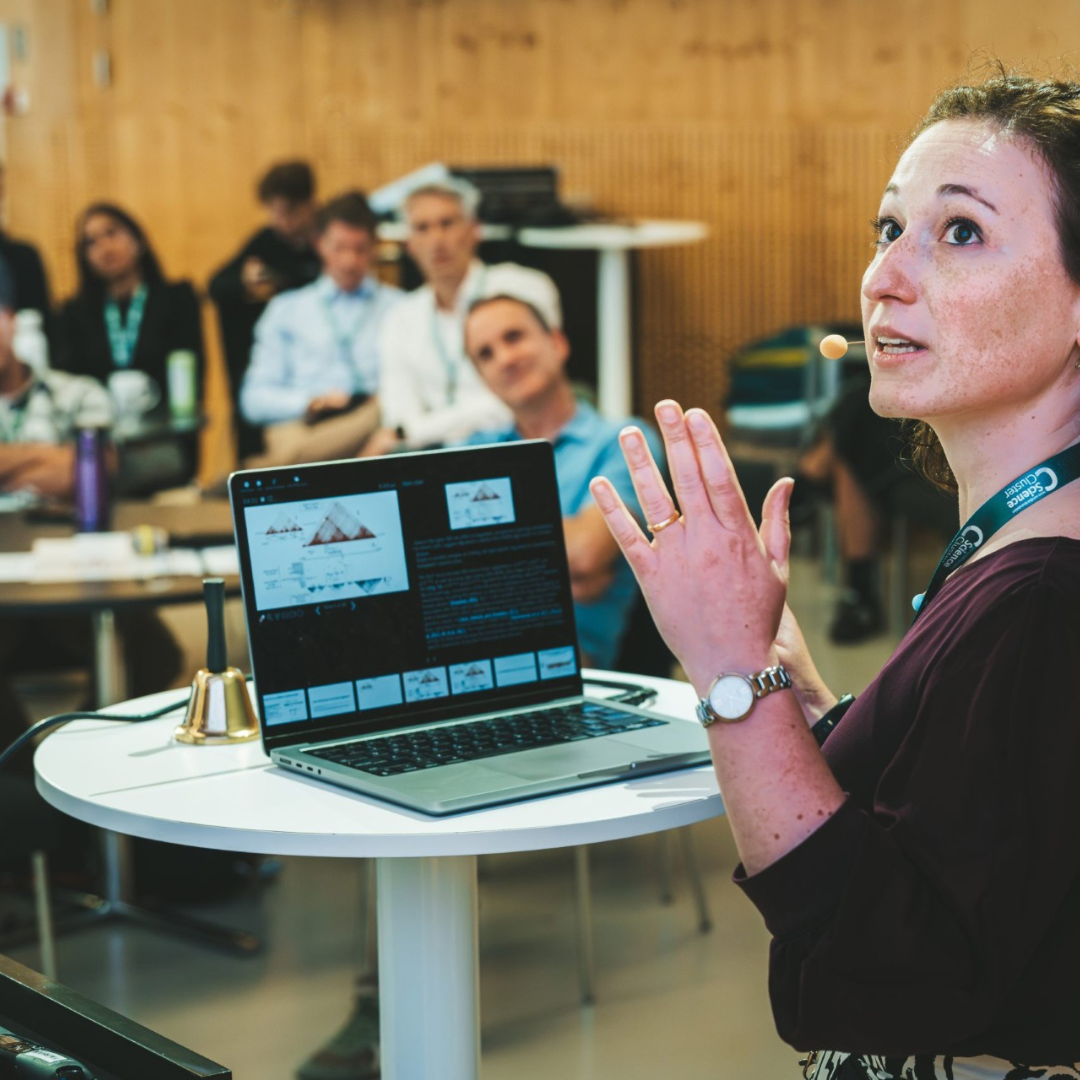
The ETT group studies how genetics and epigenetics interact to shape gene activity, and how these processes influence cell behaviour and disease development. By combining molecular experiments and computational analysis, the team maps the regulatory networks that control how cells make decisions and respond to external challenges. The group uses a new branch of genomic technologies (called single-cell genomics), which allow researchers to profile gene expression (and modalities, such as DNA accessibility) in thousands of individual cells rather than relying on population averages. These tools reveal rare cell states, subtle transitions and new layers of regulation that bulk methods cannot detect. The ETT lab uses these approaches to understand how cells change as cancer develops, for example during the development of melanoma, a type of skin cancer characterised by a very high number of changes in the DNA sequence. This research has been recently funded by a Springboard award from the Academy of Medical Sciences.
Within SBBS, and at QMUL, the ETT lab is part of collaborative hubs of researchers that use genomics to address fundamental biological questions. Research in the Centre for Evolutionary and Functional Genomics explores how genomes change across species and how genes shape biological trait. The Centre for Epigenetics unites groups aiming to identify how chemical and structural modifications of DNA influence development and disease. At QMUL, these centres interact with research institutes such as the Precision Healthcare University Research Institute (PHURI) and the Digital Environment Research Institute (DERI), which focus on large-scale patient cohorts, and cutting-edge analytical expertise, to ultimately inform data-driven clinical approaches.
Students in SBBS benefit directly from the institutional strengths in genomics, both at the undergraduate and postgraduate level. Genomics is embedded in our Biomedical Sciences (for example in the Genetics (BMD164), Human Genetic Disorders (BIO227) and Advanced Human Genetic Disorders (BIO324) modules) and Biology (in the Genes and Bioinformatics (BIO223), and Functional Genomics & Epigenetics (BIO327) modules) curricula, and is part of the MSc in Bioinformatics or in AI in Biosciences. Moreover, students have the opportunity to join research projects in laboratories, including the ETT lab. This hands on experience helps students develop both experimental and computational skills, both key aspects in modern genomic research.