
Q&A with Niharika Pandit: How militarisation becomes part of everyday life in Kashmir
Niharika Pandit is a Lecturer in Sociology in the Department of Sociology, Politics, and International Relations. Her new book, Occupying the Everyday: Militarisation and Gendered Politics of Living in Kashmir, has just been published with Oxford University Press.
/filters:format(webp)/prod01/channel_419/school-of-society-and-environment/media/school-of-society-and-environment/news-story-images/Niharika_headshot-copy.jpg)
Question: Tell us about your book. Why did you choose to focus on the everyday, quotidian aspects of occupation in Kashmir?
Answer: My book looks at how militarisation becomes part of everyday life in Kashmir. Rather than focus on spectacular violence, I look at how military occupation shapes the social relations of everyday life and how people challenge that kind of oppressive power as it circulates. Because this is a feminist study, I am interested in the ways that occupation both widens disparities around gender, racialisation and class, but also how it uses logics of gender and sexual freedom to make itself more durable. As feminist scholarship reminds us, what we do in everyday life both makes and disrupts structural power.
For example, in one of my interviews, my interlocutor drew me an illustration of all the barriers he had to go through just to take his mother to a hospital appointment. When we focus solely on big structures kof occupation, we often miss these details, like how a journey, which is maybe only five minutes away, takes two hours. Occupation creates this kind of expanded time, where basic tasks can take extremely long, producing delays and waiting in everyday life. This diagram was his way of ‘re-membering’ an experience, which is often overlooked and may never make its way into dominant ways of knowing Kashmir.
In the book I focus on the ‘everyday’ as a site where violence can be challenged and also mended. The ‘everyday’ is not simply a passive site where power just operates. I'm interested in people's stories, how people conceive of their life, how they experience occupation; but I’m also interested in counter-politics. What are anti-colonial ways of being and thinking? The ‘everyday’ is also a space of possibility rather than just a scene where violence is taking place.
Q: How does your work recenter Kashmir within the histories of India, colonialism, and nationhood?
A: The ‘Global South’ has become a term of currency, right? There is a sort of received wisdom, especially in Western scholarship, that the ‘Global South’ is a unified space, right? And that all post-colonial states share similar features, and don't have their own settler/colonial projects.
As the militarisation and occupation of Kashmir shows, the story we've been told about the postcolonial state is not as unified, nor as linear.
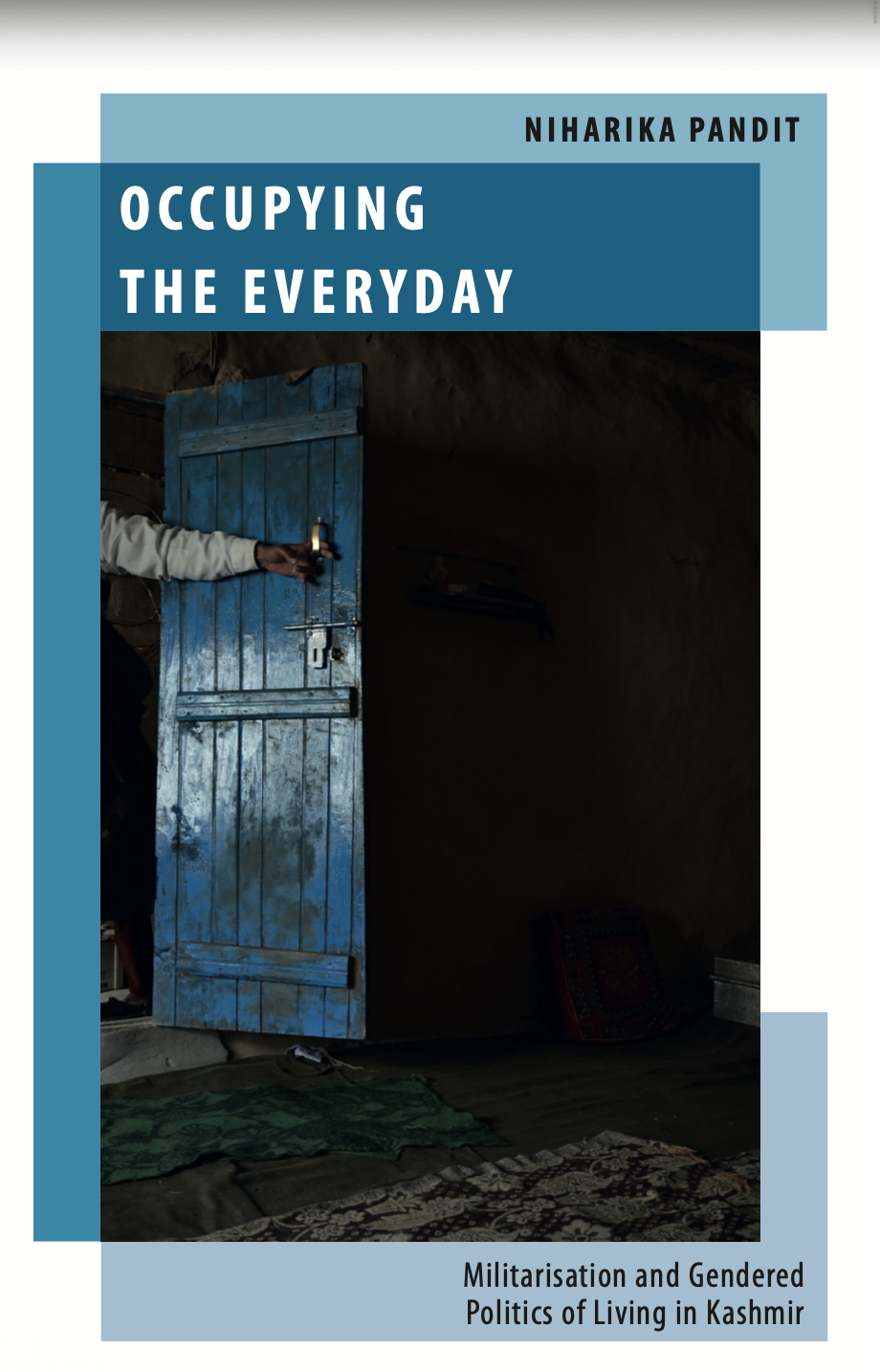
My book asks: who are these times really ‘postcolonial’ for? For us to reach a moment of collective liberation, what kind of reckoning is required with how power works. The same power that is liberatory for one person can dehumanise and violate another. So, I think with Kashmir, both as a site for listening to people's stories, and as a site from where knowledge can be produced. Often, we don't think about ‘small’ geographies as making new knowledge. But, in doing this kind of feminist work, I'm really trying to think with Kashmir as a site of feminist theory building, which challenges dominant narratives of postcolonialism and nationalism. It shows, among other things, the violence that is built into nation-building projects.
Q: Your book deploys feminist methodologies. Can you tell us more about that?
A: When we think about feminism, we tend to associate it with gender and sexuality. But I’m more concerned with anti-colonial feminist lines of thinking, which encourage us to think about new forms of political organising and world-building. Within this line of thinking, gender and sexual freedom and class struggle cannot be separated from anti-colonialism.
Whilst I employ feminist ethnographic methods, the framework of feminism has really informed the way I designed this research, the way I conducted this research, but also how I write up my research. My approach includes inviting readers to be part of the story, to take accountability and responsibility for the violence that is inflicted often on our collective behalf. So, the book is also an invitation to the readers to reckon with our complicity and our collective responsibility, especially in these violent times, globally, because as Maya Angelou reminds us, none of us can be free until all of us are free.
Question: What would you like readers to take away from the book?
Answer: We’ve reached a global conjuncture of escalating imperial violence. And these times have also led to apathy amongst many groups of people. So, what I would want readers to take away from the book is that stories we don’t normally pay attention to can change the way we see the world. I’d like readers to revel in the discomfort of knowing this. We so often run away from discomfort and want a certainty of knowing. And thinking with Kashmir can bring a lot of discomfort, particularly for those who once subscribed to dominant narratives about nationalism and post-colonialism. So, I hope readers are able to sit with that discomfort, to think with it, and really allow it to shift the way they see the world and to acknowledge the people who've been banished and subjugated.
Q: So, what’s next for you?
A: I’ve just received a small British Academy grant to work on feminist imaginaries of anti‑militarism and anti‑capitalism. Through a series of workshops, I’ve been collaborating with artists and activists involved in South Asia and doing anti-militarism work. I am also working with an artist on a co‑created zine, which explores how militarism infiltrates everyday life and imagines futures beyond it. I'm increasingly interested in greater engagement with broader communities and producing political education materials. The aim is to translate this research into more concrete political work and create education tools that can circulate across libraries in London and back in South Asia.
Interview by Keren Weitzberg