
Remembrance Day 2025: Stories Behind the Names
At this year’s Remembrance Day service passages from the Roll of Honour books held in the University Archives will be read. These books record the names of Queen Mary students who died in military service during World War 1 and World War 2. The stories of three students will be read this year and in this blog we are using other sources to fill in details of their lives beyond their military service.
/filters:format(webp)/prod01/channel_301/library/media/library/archives/john-stewart-calder-28-march-1918=sq.png)
John Stewart Calder from
John Stewart Calder (1888-1918): Sciences graduate of East college
John Stewart Calder was born in 1888 to Mr Ronald Bain Calder and Mrs Mary Campbell Calder at 21 Seagry Rd Wanstead, London.
John Stewart Calder joined East London College in 1910 studying Maths, Chemistry, Botany and Physics however he dropped Physics in his second year. Graduating in 1913 he went on to be a teacher. However, in 1914 he quit his teaching job and signed up to fight for the London Rifle Brigade (LRB) being promoted to Captain quickly. He was awarded the Military Cross and was later given a bar for his medal for showing bravery and courage in the face of danger. At the end of 1914 he took part in the famous Christmas truce sending a letter home stating:
What a strange Christmas Eve it was! Soldiers from both sides singing to each other, songs, hymns, and carols, and walking around bonfires. We came out of the trenches later on in the evening, and went into supports. And for once, we were sorry to leave the trenches for we felt ‘Christmas day’ in the trenches was going to be a remarkable day, even on Christmas Eve the firing ceased by common consent. At about two o’clock on Christmas morning a German band came out of the trenches and played carols, ‘Home Sweet Home,’ ‘Christmas, awake,’ etc. It was wonderful to hear. Some of our men who were in the trenches on Christmas Day told us the Germans were a fine set of fellows, and many could talk good English.
Published in the Essex County Chronicle 15 January 1915
This was not his only letter home he wrote often even having to write home when his brother Colin Stewart Calder died in the second battle of Arras on the 9 April 1917. He wrote:
God has relieved our darling lovely Colin from the horrors of this cruel bloody war ... God has taken him away from this awful turmoil and suffering caused through ambitious sin and men gone mad... do not let this bereavement crush you. Colin would not wish it. His tour of duty is over, but we must and will carry on. Carry on bravely... and in our prayers let us remember the bereaved ones of all nations friend and foe alike
Letter quoted on Great War Forum
John Stewart Calder was not far behind his brother however, as on the 28 March 1918 during the bloody German Spring offensive Calder was lost in action protecting a strategic point in the French city of Arras. John lay there in an artillery hole barely holding on to life when the man next to him a student he used to teach cried out for water. John gave him his thermos that was full of coffee.
When word got home that he was missing his family put up an advertisement in the newspaper begging anyone who had any information to call as there would be a reward for any news of their son. This led to a hoaxer called Harry Banks calling up pretending to be a soldier who had seen John alive at the prisoner of war camp they were supposedly both sent. When it was revealed in 1918 that Calder had died many months before meaning Banks had not seen Calder at the prison camps, the Calder's did not take lightly to this, and Harry Banks was sentenced to 6 months in prison in 1919.
He is remembered on the Arras Memorial, Faubourg-d'Amiens Cemetery, Pas de Calais, France. He is also remembered in the East London College War Record 1914-1918 and on the Wanstead war memorial.
Herbert “Molly” Randal Mollekin (1923-1942): Engineering student of Queen Mary College
Herbert was born on the 28 September 1923 to George Herbert Mollekin who was a builder and his first wife Mary Allison. He lived on Rotherham Road, Maltby.
He started his education at Maltby Grammar School from 1934-1939 before moving to Rotherham technology college from 1939-1940. He studied Engineering: drawing, pure maths, applied maths, heat, electricity, magnetisation, sounds and optics at Queen Mary College from 1940-42 but he was unable to finish his degree as he was conscripted. While studying he lived in college lodgings at 90 Milton Road Cambridge. He was part of the Socialist Society, Engineering Society and the Debating Society. He was also part of the University of London Officer’s Training Corps from 1941-42.
However, he was also part of a society called ‘the club’ which was formed at the end of 1941. The purpose of the club was to do nothing but have an enjoyable time; sometimes they would debate others they would mess around it was not a formal club like the others it was a group of friends making a way for them to mess around. By 1943 they believed that they should solve debates and issues with table tennis matches. This sadly never came to fruition.
Once he had been called up to fight, he joined the Medical Corp which was the corps that trained field medics and doctors for frontline duties and was sent to Northen Italy to help with ‘operation Olive’ which was trying to break the ‘Gothic line’ and advance into Northen Italian and Southern German territories. While he was ‘holed up’ in a house his Captain was hit by the enemy. As the groups medic he went to go and give assistance but was hit by a sniper. This is a war crime.
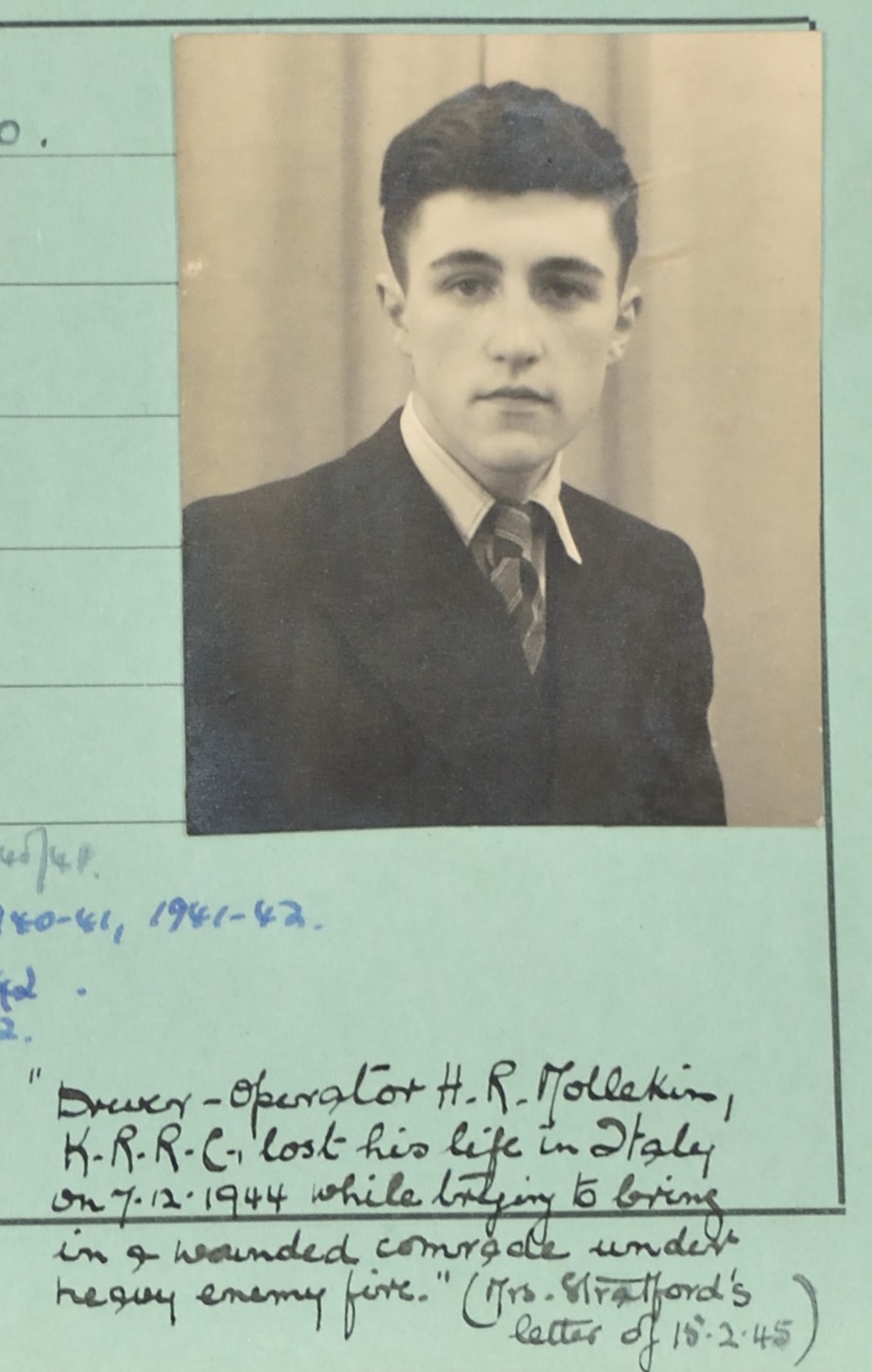
Herbert also had a girlfriend named Margaret who worked for the ‘NAAFI’ (Navy, Army, Airforce, institute) where they met. After the war Margaret held on to the photographs she had of Herbert but upon her death her daughter returned the pictures to Herbert's family.
He is buried in Faeza Cemetery near Bologna, Italy. He is also remembered on the Queen Mary College Roll of Honour 1939-1945 and Rotherham War Memorial.
Image: Herbert R Mollekin's Queen Mary College student card [ref. QMC Student Cards]
Peter Lewis Kenner (1919-1940): Engineering graduate of East college London
Peter was born on the 7 September 1919 to Thomas William Kenner and Gladys Kenner on 12 Robin Hood Road, Brentwood, Essex.
He was first educated at Brentwood school, and he attended East London College on a scholarship from 1937-1939 studying Engineering graduating in 1939 he studied applied aerodynamics, theory of machines and effect of technology, among others. While at the university he was part of the Hockey and Fencing teams and was awarded half college colours (an award for being good) for hockey in 1938 he was the honorary treasurer of the men's hockey club 1938-39 and honorary secretary of the Union Society 1939-40. After graduating he joined the Old Students Association.
He was part of the London Universities air squadron from 1937-38 and was commissioned in the Royal Airforce Volunteer Regiment in 1939. He was called up to fight on 1 September 1939 and finished his training on 23 June 1940. His squadron (264th) moved to Hornchurch in East London on the 21 August 1940.
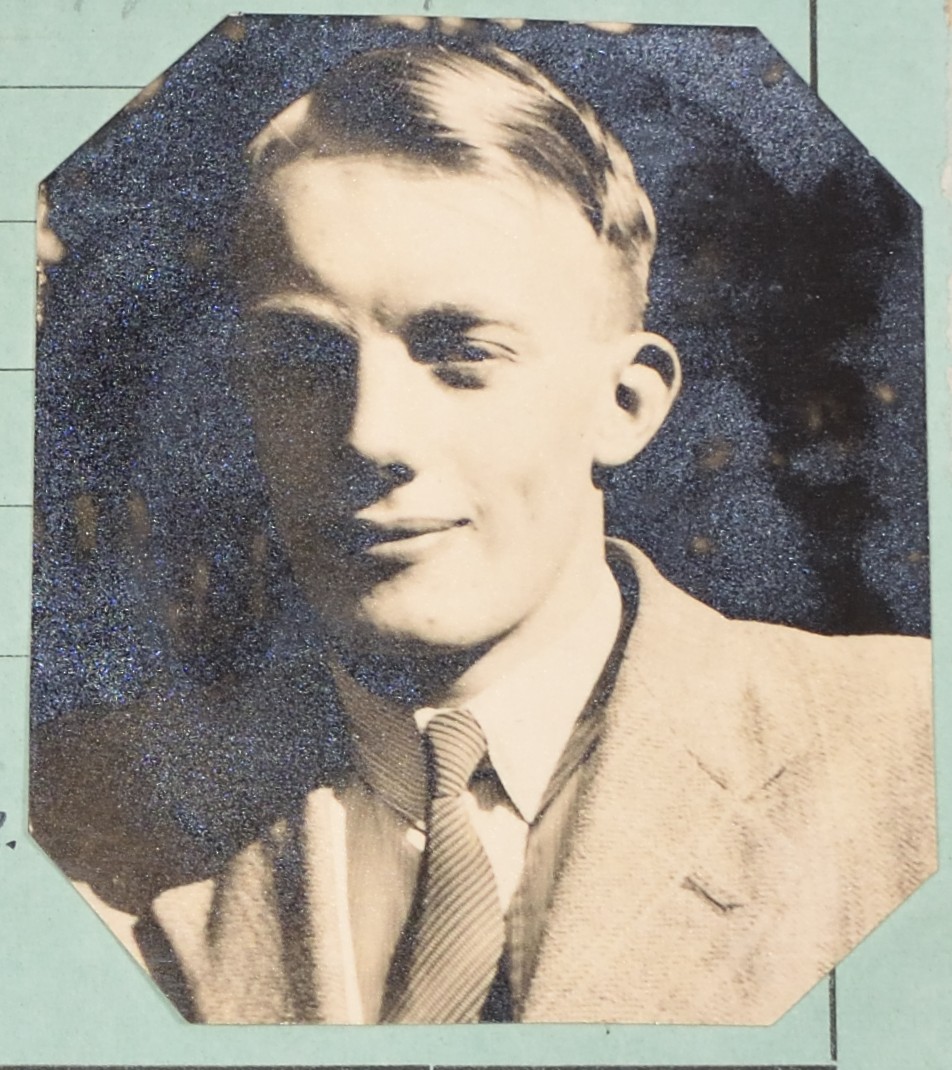
Peter was shot down over Thanet in East Anglia seven days later (28 August). He was defending against a group of German bombers heading towards Liverpool for the beginning of the Liverpool blitz. He and his gunner CE Johnson both died; their plane crashed in flames on Silliboume Farm, Hinxhill.
He is buried in Brentwood Cemetery, commemorated on the Battle of Britain Monument London and in the Queen Mary College Roll of Honour 1939-1945.
Image: Peter Lewis Kenner's Queen Mary College student card [ref. QMC Student Cards]
How to find out more
Interested in finding out more about another student? Start with the below sources which are either online or available to view by appointment in the Archives Reading Room:
Queen Mary College Student Index Cards c1910-1960s, Queen Mary University Archives
East London College Roll of Honour 1914-1919, Queen Mary University Archives
Queen Mary College Roll of Honour 1939-1945, Queen Mary University Archives
Meanings of Service website, digitised material relating to the First World War held at the Queen Mary University of London, Royal London Hospital and St Bartholomew’s Hospital archives.
University of London Students 1836-1939, digitised copies of lists of students and University of London graduates, 1836-1939 made available through Senate House Library