
Study highlights the hidden climate cost of the Israel–Gaza war
A new study led by Queen Mary University of London estimates that the Israel–Gaza war has generated around 33 million tonnes of carbon dioxide equivalent (CO₂e), highlighting the often-overlooked environmental impact of armed conflict.
/filters:format(webp)/prod01/channel_262/queen-mary-university-of-london/media/hss/Infographic_640.png)
Infographic showing climate cost of Isareal-Gaza war
Published in the journal One Earth, the research provides a comprehensive analysis of emissions linked to military activity, infrastructure development and post-conflict reconstruction. The research builds on earlier work examining emissions during the first months of the conflict.
The researchers found that emissions from active military operations alone exceeded 1.3 million tonnes of CO₂e, including emissions associated with artillery, rockets and other military equipment.
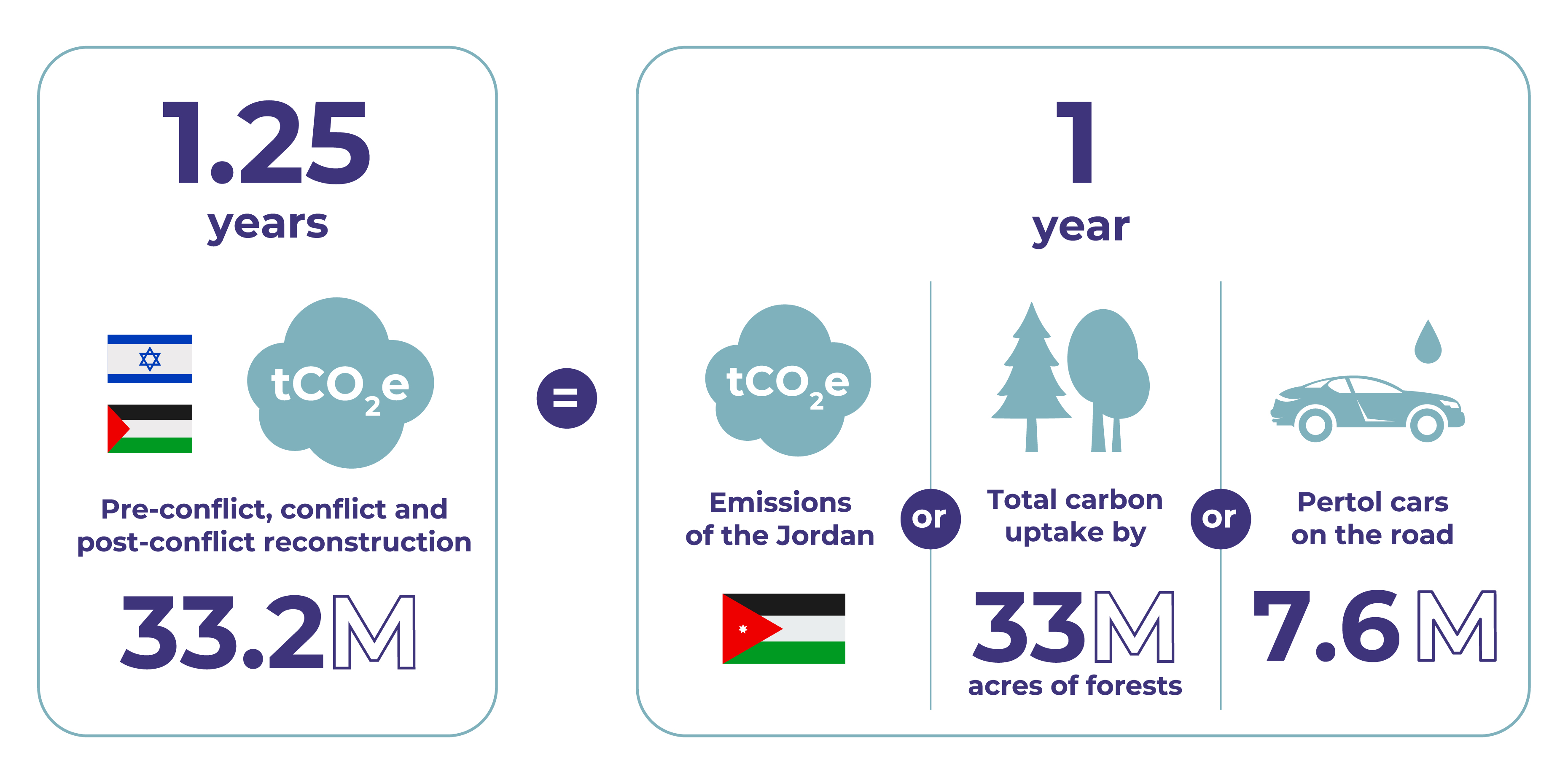
Graphic illustrating estimated lifecycle emissions linked to the Israel–Gaza war (33.2 million tCO₂e). Credit: Dasha Kurinna / One Earth (Cell Press)
The analysis also considers emissions linked to the construction of defensive infrastructure and the substantial carbon footprint associated with rebuilding damaged roads, buildings and other essential infrastructure following the conflict.
Dr Benjamin Neimark from Queen Mary University of London, lead author of the study, said:
“Armed conflicts cause immense humanitarian and economic harm, but their environmental consequences are rarely quantified. Our research shows that war can generate substantial greenhouse gas emissions, from active military operations through to the rebuilding that follows.”
Dr Frederick Otu-Larbi from Lancaster University and the University of Energy and Natural Resources in Ghana added:
“Understanding the environmental impacts of conflict is essential if we are to fully account for the drivers of climate change. Greater transparency around military emissions will help ensure these impacts are no longer overlooked.”
The researchers note that military emissions are largely excluded from international climate reporting frameworks, meaning the environmental impact of warfare is often absent from global climate accounting.
The study calls for greater transparency in the reporting of military emissions through international mechanisms such as the United Nations Framework Convention on Climate Change (UNFCCC).
The research was led by Queen Mary University of London and conducted in collaboration with researchers from Lancaster University, the University of Energy and Natural Resources in Ghana, the Climate and Community Project, the Conflict and Environment Observatory, and the Initiative on GHG Accounting of War.
Read the full paper here: https://www.cell.com/one-earth/fulltext/S2590-3322(26)00049-7
Related items
/filters:format(webp)/prod01/channel_262/queen-mary-university-of-london/media/qmul/media/news/items/hss/_(150-x-115-px)-(640-x-410-px).png)
 News story:
Sponsorship is key to progressing the leadership pipeline, but why do only a quarter of these relationships work?
News story:
Sponsorship is key to progressing the leadership pipeline, but why do only a quarter of these relationships work?
7 July 2026
/filters:format(webp)/prod01/channel_262/queen-mary-university-of-london/media/hss/Afteburner_640.png) News story:
War in Iran has already produced emissions equivalent to a year of Iceland’s carbon output
News story:
War in Iran has already produced emissions equivalent to a year of Iceland’s carbon output
25 March 2026
/filters:format(webp)/prod01/channel_262/queen-mary-university-of-london/media/hss/SMA_MOIN_NB_640.png) News story:
New book explores how storytelling and imagination can reshape marketing education
News story:
New book explores how storytelling and imagination can reshape marketing education
3 March 2026