The President and Principal’s Fund for Educational Excellence
The President and Principal’s Fund for Educational Excellence was established to encourage a culture of educational innovation and exploration at Queen Mary.
Funded Projects 2025/26
Funding has been awarded to eight projects in the following priority areas:
- Assessment (eg use of authentic assessment, artificial intelligence)
- Curriculum Development, embedding the Principles of Academic Degree Programme Design (e.g. in the areas of teaching and learning approaches and activities, employability
Developing an EDI engineering employability learning toolkit in partnership with students – enhancing employability and graduate attributes for women and global majority engineering students – Project leads: Sara Hajikazemi and Salim Salim (School of Engineering and Materials Science). Collaborators: Hicham Adjali, Folashade Akinmolayan, Mouna Chetehouna, Sanaa Hafeez and Saqib Jivani.
Oral Surgery Risk Assessment (OSRA): A Mobile Application to Support Clinical Reasoning and Guideline Compliance in Health Education – Project lead: Haidar Hassan (Blizard Institute). Collaborators: Atif Matin and Hussain Al-Tamimi.
A Plagiarism Detection Tool for Jupyter-Notebooks used in Assessments: JBEval – Project lead: Nikesh Bajaj (School of Physical and Chemical Sciences) Collaborators: Jesús Carrión, Dimitris Chiotis, Ammar Naich and Kaushal Yadav.
Aligned by Design: Co-creating Ethical and AI-Enhanced Assessment and Feedback at QMUL - Project leads: Luigi Ventimiglia (School of Economics and Finance) and Paulo Oliva (School of Electronic Engineering and Computer Science) . Collaborators: Farrah Arif, Claire Cooper, Thomai Filipelli, Eva Galante, Nick Hostettler, Daniela Tavasci and Eileen Tipoe.
Co-Creating Resources to Support the Integration of Employability into Curriculum and Assessment – Project leads: Georgy Petrov and Sevil Yesiloglu (School of Business and Management). Collaborators: Luis Carabantes, William Monteith, Usman Naeem, and Lindsey Shirah.
Professionalism: A Cross-Disciplinary Forum Theatre Initiative to Address Sexual Misconduct in Healthcare Education - Project lead: Amitha Ranauta (Institute of Dentistry). Collaborators: Dominic Hurst and Martin O’Brien.
Empowering Educators to Embed Learner Engagement Analytics in Curriculum Design - Project leads: Usman Naeem (School of Electronic Engineering and Computer Science) and Vindya Wijeratne (School of Electronic Engineering and Computer Science). Collaborators: Habiba Akter, Megan Jones, Dimitris Kalogiros, Maryam Malekigorji, Georgy Petrov and Sevil Yesiloglu.
Preparing Future Clinicians: An Innovative Co-created Framework for Embedding Artificial Intelligence in MBBS and BDS curricula – Project leads: Sushma Saksena (Institute of Health Sciences Education) and Cassandra Lewis. Collaborators: Chie Adachi, Shabana Bharmal, Mohamed Elbadawi, Nick Fisher, Catherine Molyneux Joshua Soane (FMD) and Lindsey Shirah.
Drapers’ Fund for Innovation in Learning and Teaching 2025/26
Who experiences experiential learning? Enhancing inclusion in experiential education – Project lead: David Geiringer (School of History). Collaborators: Aisha Abuelmaatti, Alison Blunt, Leslie James, Patrick McGurk, Lisa Morrison, Kanishka Ratnayake, Rehan Shah, Lindsey Shirah and Karen Watton.
/filters:format(webp)/prod01/channel_311/queen-mary-academy/media/qm-academy/innovation-and-learning-/AI-eduthon-image.jpg)
Funded projects 2024/25
Creating an open, co-created and co-guided toolkit to support staff integration of AI literacy and skills into the curricula - Lilian Schofield (School of Business and Management), Xue Zhou (School of Business and Management), Daniela Tavasci (School of Economics and Finance), Lesley Howell (School of Physical and Chemical Sciences), Aisha Abuelmaatti (School of Electronic Engineering and Computer Science) and Cassandra Lewis (Institute of Dentistry)
Making Diversity Count, Fixing the Leaky Pipeline - Giorgio Chianello (School of Physical and Chemical Sciences) and Tippu Sheriff (School of Physical and Chemical Sciences)
Critical hope: co-creating learning resources for a changing world [PDF 320KB] - Catherine Nash (School of Geography) and Heather McMullen (Wolfson Institute of Population Health)
Empowering Neurodivergent Voices: Co-creation or Peer Support Strategies in Education - Ruth Rose (School of Biological and Behavioural Sciences, Lesley Howell (School of Physical and Chemical Sciences), Sally Faulkner (School of Biological and Behavioural Sciences) and Mark Hudson (School of Physical and Chemical Sciences)
Future Ready: Integrating Artificial Intelligence, Interdisciplinary Practices, and Entrepreneurial skills for Enhanced Student Employability - Aisha Abuelmaatti (School of Electronic Engineering and Computer Science), Jo Elliott (Medicine and Dentistry), Karen Watton (School of Law), Leon Vinokur (School of Economics and Finance), Paraskevi Argriou (School of Biological and Behavioural Sciences), Pedro Elston (Institute of Health Sciences Education), Veronica Veleanu (School of Economics and Finance), Weronika Fernando (School of Languages, Linguistics and Film) and Xue Zhou (School of Business and Management)
SustainAbility in the curriculum: Developing Queen Mary's virtual greenspace for sustainability awareness [PDF 655KB] - Sayed Elhoushy (School of Business and Management - HSS), Ishani Chandrasekara (School of Business and Management - HSS), Nurul Ahmed (Careers and Enterprise - PS), Paul Clatworthy (Careers and Enterprise - PS), Sally Faulkner (School of Biological and Behavioural Sciences - S&E), Patrick Healey (School of Electronic Engineering and Computer Science - S&E), Anna Moore (Wolfson Institute of Population Health - FMD), Jonathan Otter (Queen Mary Student Union - PS), Jovani Palnoni (Queen Mary Student Union - PS), Rehan Shah (School of Engineering and Materials Science - S&E), Jenna-Marie Smallwood (Estates - PS), Zoe Sturgess (Queen Mary Student Union - PS), Chris Sutton (School of Mathematical Sciences - S&E), Sara Tomé (Estates - PS), Louise Younie (Institute of Health Sciences Education - FMD) and Alison Blunt (School of Geography - HSS)
Enhancing Data Science Education through Competitive-Based Learning and AI-Driven Assessment [PDF 495KB] -Pengfei Fan (School of Electronic Engineering and Computer Science - S&E), Jesus Carrion (School of Physical and Chemical Sciences - S&E), Nikesh Bajaj (School of Physical and Chemical Sciences - S&E), Jordan Smith (School of Electronic Engineering and Computer Science - S&E), Ebru Burcu (S&E), Gloria Molinero (School of Electronic Engineering and Computer Science - S&E) and Reza Moosaei (School of Electronic Engineering and Computer Science - S&E)
Drapers’ Fund for Innovation in Learning and Teaching 2024/25
EduMark AI: AI-Driven Grading and Personalised Student Feedback to Save Educator Time - Deepshikha Deepshikha (School of Engineering and Materials Science), Conrad Bessant (School of Biological and Behavioural Sciences), Darryn Mitussis (School of Business and Management), Li Wang (School of Engineering and Materials Science), Xinru Deng (School of Engineering and Materials Science), Giuseppe Viola (School of Engineering and Materials Science) and Mouna Chetehouna (School of Engineering and Materials Science)
Funded projects 2023/24
President and Principal's Fund for Educational Excellence 2023/24
- AI for student learning and research - Nick Fisher, Dr Cassandra Lewis (Institute of Dentistry); Paula Funnell, James Soderman, Chenee Psaros, Sharlin Ahmed, Rosella D'Alesio (Library), Dr Pedro Elston, Rofique Ali (Institute of Health Sciences Education); Dawn Buzzard, Catherine McLean (TELT) and student collaborators
- Co-creating AI best practices in higher education (HE): Building AI skills enhancement resources through interdisciplinary Student-Staff Best Practice Sharing Sessions - Dr Xue Zhou, Dr Joanne Zhang, Dr Lilian Schofield (School of Business and Management); Dr Lesley Howell (School of Physical and Chemical Sciences); Dr Aisha Abuelmaatti (School of Electronic Engineering and Computer Science)
- East London Atlas Project [PDF 3,189KB] - Dr Elsa Noterman, Dr Alex Henshaw, Dr Andrew Russell, Dr Philippa Williams (School of Geography)
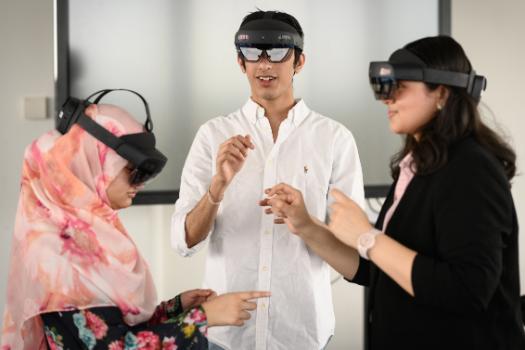
- Empowering Skill-Based Education through Virtual Reality - Dr Lesley Howell (School of Physical and Chemical Sciences); Professor Chie Adachi (Faculty of Medicine and Dentistry); Dr Pedro Elston (Institute of Health Sciences Education)
- ePortfolio Based Learning for Personal and Professional Development, using the Graduate Attributes Framework - Dr Timothy Fulton and Dr Sally Faulkner (School of Biological and Behavioural Sciences)
- ‘GenAIrating’ Critical Clinical Thinking: A new approach to learning using large language models - Dr Stuart Miller, Ian Griffiths, Dr Simon Lack, Dr Manuela Angioi, Prof Dylan Morrissey (William Harvey Research Institute), Dr Esther Murray (Institute of Health Sciences Education)
- Get spotted! a podcast series and a masterclass on communicative practices that make you stand out at university and in your dream job! - Dr Weronika Fernando and Dr Saima Sherazi (School of Languages Linguistics and Film)
- How might we create spaces that support human flourishing, enabling students and staff to thrive and innovate? - Dr Louise Younie, Dr Rofique Ali, Dr Nandini Hayes, Vanessa Thompson (Institute of Health Sciences Education); Professor Chie Adachi (Faculty of Medicine and Dentistry); Dr Nicholas Hostettler (School of Politics and International Relations); Marianne Melsen (QMSU)
- QMCUR (Queen Mary Centre for Undergraduate Research) - Dr Giuseppe Viola, Dr Maria Romero Gonzalez, Professor Henri Huijberts, Professor Julia Shelton (School of Engineering and Materials Science)
Drapers’ Fund for Innovation in Learning and Teaching 2023/24
- Innovative and diverse creation of teaching materials in Economics, Finance and Business Management: new approaches in the classroom with co-creating Research-Led, Learning by Doing, Peer-Led Team Learning and Teaching with Historical Perspectives - Dr Daniela Tavasci, Dr Eileen Tipoe, Dr Luigi Ventimiglia (School of Economics and Finance); Dr Xue Zhou and Dr Lilian Schofield (School of Business and Management)
/filters:format(webp)/prod01/channel_311/queen-mary-academy/media/qm-academy/innovation-and-learning-/PPFEE-VR-project-FWI.jpg)