
MSc Students Share Their Dissertation Poster Experience
Hear from postgraduate students across our MSc programmes about their experience presenting their dissertation research through academic posters. From mental health and Alzheimer's disease to plastic pollution, students reflect on the process of creating and presenting their posters, the skills they developed, and how the experience strengthened their confidence as researchers.
/filters:format(webp)/prod01/channel_120/school-of-biological-and-behavioural-sciences/media/sbbs/images/Aiden-Poster-(1).jpg)
Aiden Peckham: MSc Psychology Conversion
My research is a qualitative study looking at private practitioner perspectives on “good fit” and LGBTQ+ affirmative best practice in UK talking therapies, using minority stress theory as a sensitising lens. We already know a great deal about LGBTQ+ mental health disparities and how poor service fit can compound difficulties faced by the community, so my project explores what affirmative practice looks like from therapists’ perspectives.
Creating the poster was really useful professionally, as it helped me condense a dissertation’s worth of knowledge into a clear and digestible narrative for people outside my research area. The poster also helped me solidify my own understanding of the key points, my research gap, and why the work matters, which was great motivation and a confidence boost going into the interviews. Presenting it was a valuable opportunity to communicate the project more confidently, and Queen Mary has been very supportive throughout, providing us with dedicated dissertation lectures and materials on QMPLUS. In particular, my academic tutor, Dr Cristina Cioffi, has been incredibly organised, supportive, and knowledgeable, and she has built a really strong foundation for those of us in her team we feel incredibly supported under her guidance.
Learn more about Psychology Conversion
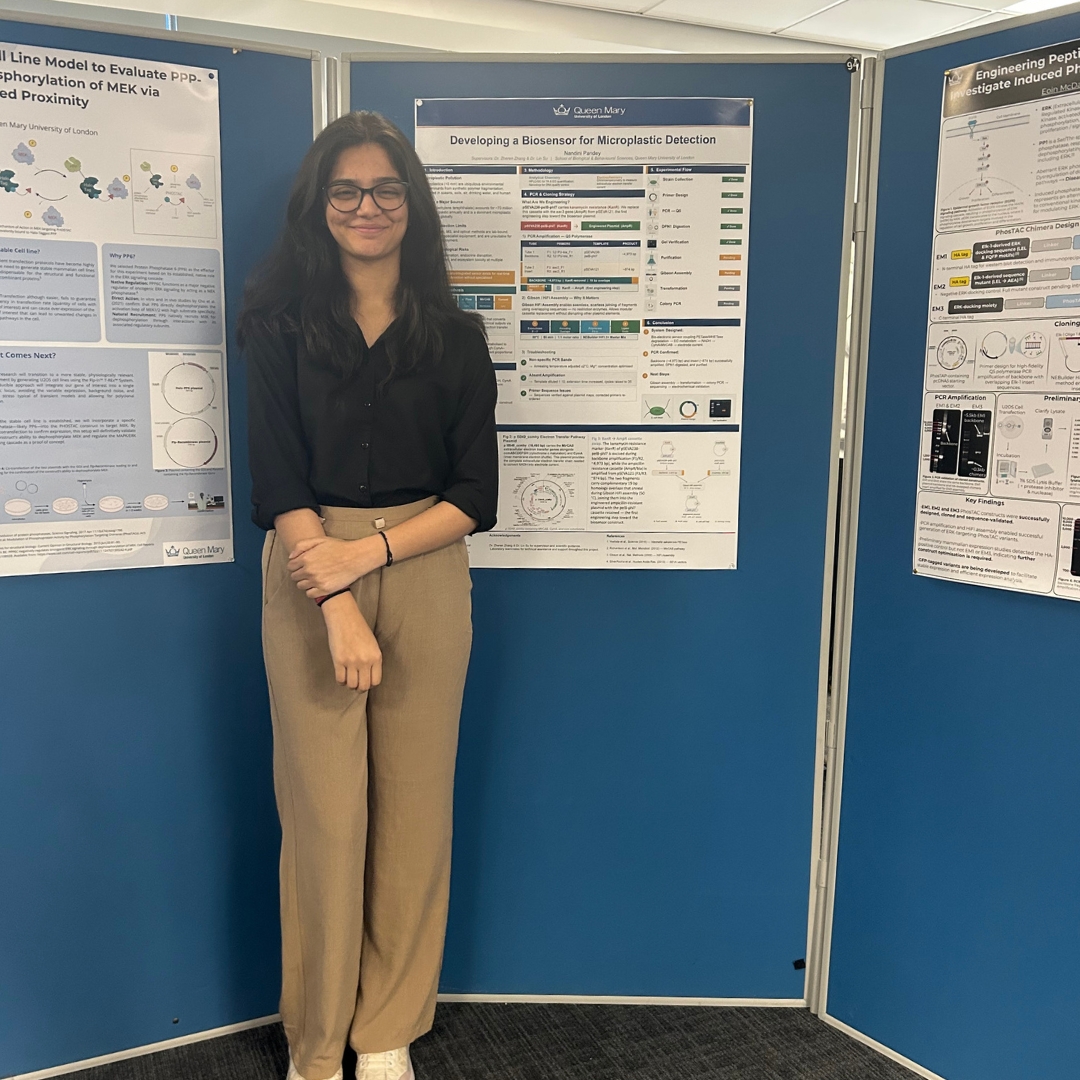
Nandini Pandey: MSc Biotechnology
My research focuses on engineering E.Coli to detect plastic pollution. The bacteria break down PET, the material used to produce plastic drink bottles, and in doing so generate a small electrical current that can be measured. This enables the degradation of plastic to be monitored in real time, which I find a genuinely compelling prospect.
Presenting the work proved less daunting than I had anticipated, an outcome I attribute in large part to my experience as a Student Ambassador. Explaining science to prospective students and their families at open days has taught me how to communicate complex ideas clearly and accessibly, and the poster session drew on much the same skill set. The greater challenge lay not in presenting the work but in designing the poster itself. Given the many components of my project, condensing the material onto a single page required considerable thought and refinement.
I am grateful for the support I received from my supervisors and the School throughout this process. That said, it is the ambassador experience I regard as most valuable, as it is the reason I was able to approach the day with confidence and a real sense of pride rather than apprehension.
Learn more about MSc Biotechnology
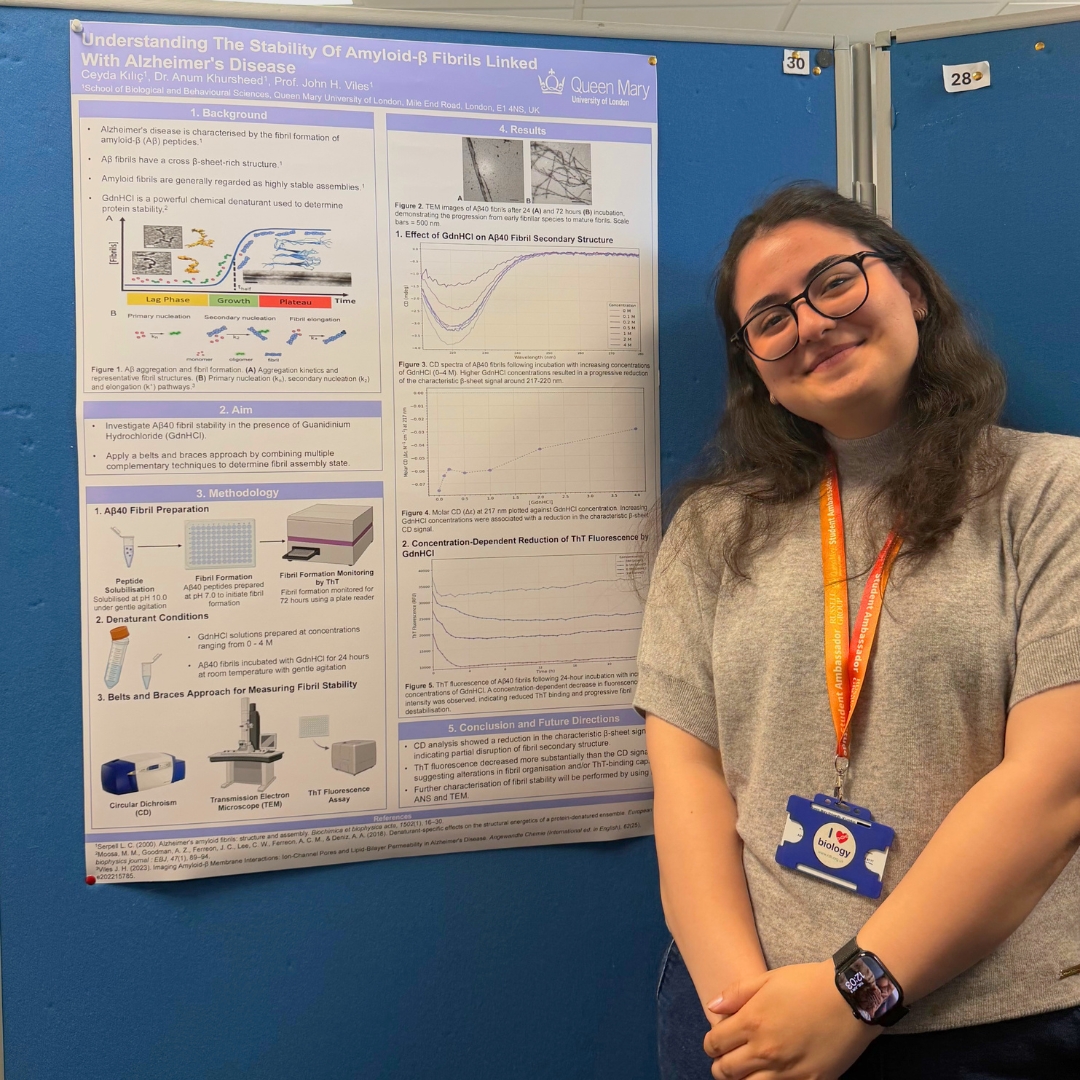
Ceyda Lilic: MSc Molecular Cell Biology
As part of the six-month research project within my MSc Molecular Cell Biology programme at Queen Mary University of London, I joined Professor John Viles’ research group to investigate the stability of protein structures associated with Alzheimer’s disease. The project gave me the opportunity to explore an area of science that has interested me for several years while developing my skills as an independent researcher.
For my MSc project, I investigated how stable these protein aggregates are under different chemical conditions. These aggregates, known as amyloid fibrils, accumulate in the brains of people with Alzheimer’s disease and are considered one of the disease’s defining features. Although they are often regarded as highly stable structures, there is still much to learn about how they respond to changes in their environment and whether they can be disrupted under certain conditions.
Throughout the project, I was fortunate to receive support not only from Professor Viles but also from Dr Anum Khursheed, whose day-to-day guidance was invaluable. From troubleshooting experiments to discussing results and refining experimental approaches, she helped me develop both practical laboratory skills and confidence in interpreting complex datasets. Working closely with experienced researchers gave me a much deeper understanding of how scientific research is conducted beyond what can be learned in the classroom.
As part of my MSc research project, I also had the opportunity to present my work as a scientific poster. Preparing the poster challenged me to communicate a complex research project in a clear and engaging way by highlighting the most important aspects of my work and presenting them in a concise format. Presenting my research gave me the opportunity to discuss my project with academics and fellow students, answer questions, and receive valuable feedback that encouraged me to think about my research from different perspectives. It also gave me greater confidence in communicating scientific research. The combination of practical laboratory training, data analysis, critical evaluation of scientific literature, and the support I received from Professor John Viles and Dr Anum Khursheed throughout my project helped prepare me for this experience.
Beyond the scientific findings, this project has strengthened my experimental, analytical and problem-solving skills. It has also reinforced my ambition to pursue a research career in neurodegenerative diseases. Alzheimer’s disease has had a personal impact on my family, which is one of the reasons I became interested in this field. Having the opportunity to contribute to research that aims to improve our understanding of the disease has therefore been particularly meaningful. My time at Queen Mary has not only allowed me to develop as a scientist but has also confirmed my desire to continue working towards a better understanding of neurodegenerative disorders in the future.
Learn more about Molecular Cell Biology