
/filters:format(webp)/prod01/channel_387/digital-education-studio-/media/digital-education-studio/images/newsletter/Dr-Saroash-Shahid.png)
At the Anatomical Society Winter Meeting 2025, I had the opportunity to present a poster on our recent pilot exploring immersive anatomy teaching using co-created 2D and 3D TINALP models in virtual reality, following up on a joint project between the Institute of Dentistry and the Digital Education Studio. The meeting’s focus on anatomy education created a useful space to discuss not just technology, but how students actually learn complex spatial content.

Click to enlarge
One of the most valuable insights from presenting was how strongly the conversation centred on visualisation. Many colleagues recognised the same challenge we face in head and neck anatomy: students are expected to build a 3D understanding from largely 2D resources. Conference discussions repeatedly highlighted that anatomy is an inherently visual discipline and that static slides alone rarely provide the depth of engagement students need. There was clear interest in how our phased, flipped design used structured preparation, active in-class tasks, and a final immersive VR session to support spatial understanding and confidence. Questions often focused on model accuracy and feasibility—highlighting that pedagogical design matters as much as the technology itself.
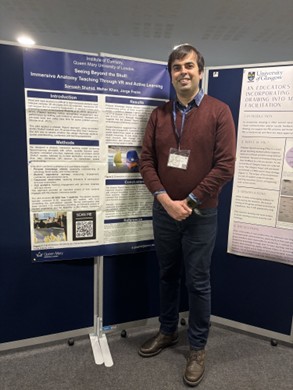
A recurring theme across the meeting was whether immersive technologies can replace dissection. The consensus was clear: they should not. Delegates frequently emphasised that cadaveric dissection and prosections offer distinct and irreplaceable advantages, particularly in tactile understanding, material realism, and the professional formation that comes from working with physical specimens. Instead, XR works best as a complementary approach—bringing aspects of the anatomy lab into classrooms and home settings where access is otherwise limited. Immersive and 3D environments were widely discussed as running in parallel with traditional methods rather than substituting them, extending access and visual exploration beyond the laboratory rather than replacing it. This aligns closely with what we observed in the pilot: immersive activities supported clearer visualisation, more focused peer discussion, and greater engagement when paired with structured preparation rather than used in isolation.
Looking ahead, I see the most creative potential in combining physical, digital, and immersive approaches rather than treating them as alternatives. As XR tools mature, the opportunity lies in designing learning sequences that deliberately move students between these spaces—supporting anatomy as the deeply visual, applied discipline that it is.
By Dr Saroash Shahid