A Week in Trinidad & Tobago: QMLAC Exchange at the Hugh Wooding Law School!
In November 2025, we were fortunate enough to be selected by the Queen Mary Legal Advice Centre to undertake a clinical legal exchange at Hugh Wooding Law School, in Trinidad and Tobago. We applied for this exchange as we are both deeply committed to access to justice and pro bono work. This exchange was an opportunity to deepen our understanding of social justice within a different jurisdiction and to explore how we could continue to foster our social conscientiousness in our future careers.
By Renite Gosal and Rosabella Rajack
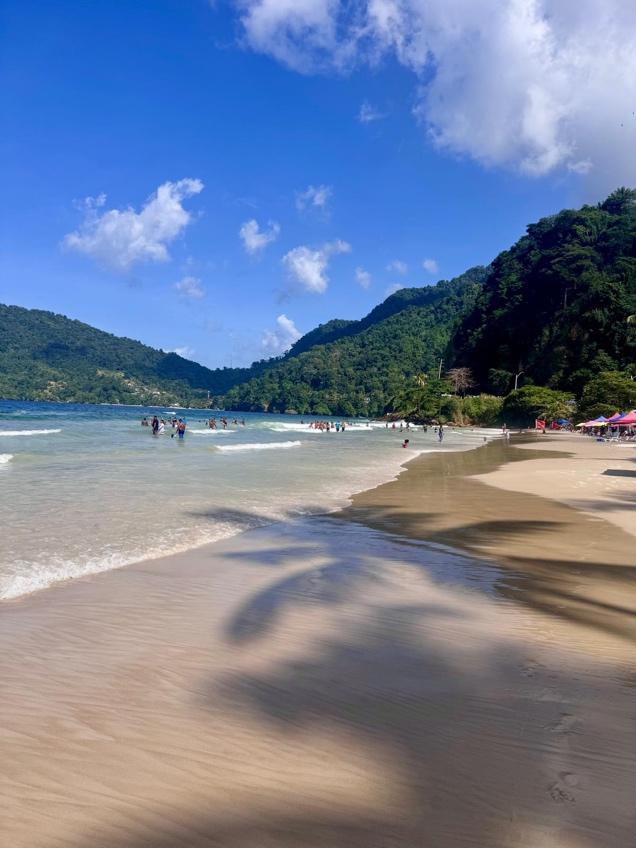 From the moment we landed, Hugh Wooding Law School staff made us feel at home. Before the hard work began, on Sunday, we were warmly welcomed into the home of Mr Jason Nathu, who alongside Ms Gail Persad, generously took the time to show us some of the beautiful island of Trinidad. We were afforded the opportunities to; try shark and bake (a delicious local dish), swim in the warm Caribbean Sea, and meet Mr Nathu’s lovely family. The day we spent with Mr Nathu and Ms Persad will stay with us forever, a beautiful memory of the touching kindness we experienced throughout our time in Trinidad.
On Monday, we were fortunate enough to shadow a former Queen Mary University of London student, Master Nazeera Ali within a Trinidadian Child Court. We attended five hearings on various matters during our time in the court and we were struck by the strong sense of calm which Master Ali brought to some very sensitive and emotionally charged matters. We were particularly interested in the different roles of various bodies in the proceedings. For instance, the Children’s Authority and the role of the Court Children’s Officer were of particular interest to us, as they each play distinct yet complementary roles in safeguarding children’s welfare (the Authority focusing on protection and intervention, while the Court Children’s Officer provides the court with independent assessments and advocacy to ensure that the child’s best interests remain at the centre of every decision). Our time at the Children Court provided valuable insight not only into the local procedure in such matters, but also into the practical realities of the system in which the court operates. Master Ali spoke to us about the ongoing placement crisis currently affecting Trinidad. A challenge she continuously navigates and considers when making orders and decisions of behalf of children.
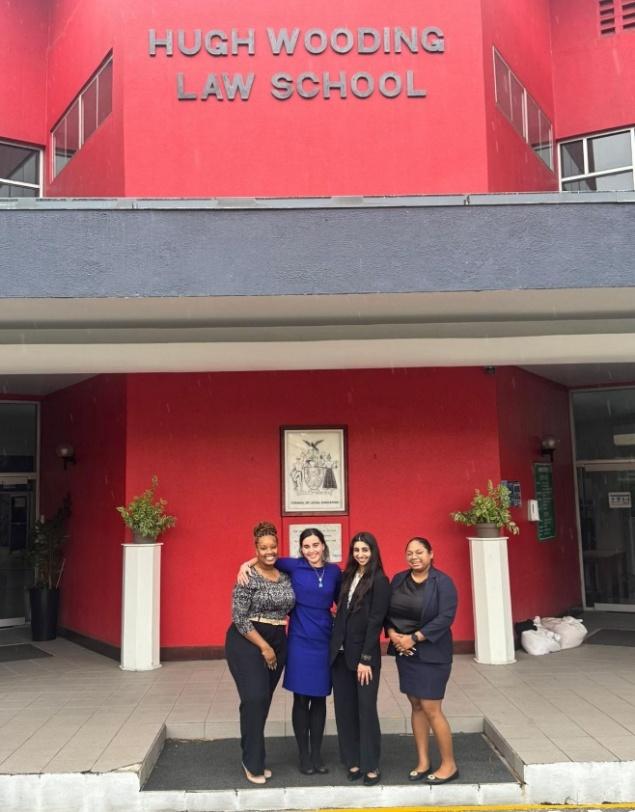
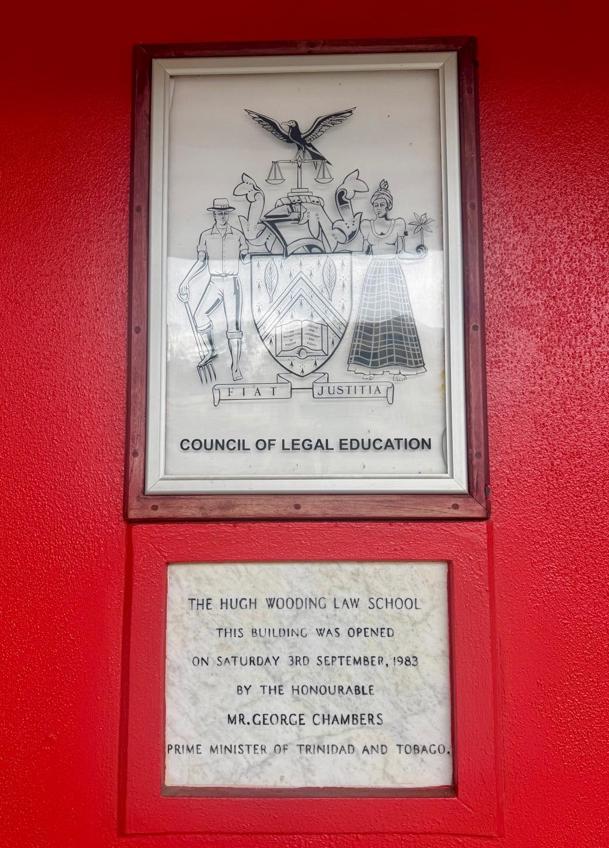
On Tuesday, we attended the Hugh Wooding Law School. We were welcomed warmly by everyone we met, from clinic staff to students, and were truly touched by the kindness and friendliness we experienced. Starting the day with Ms Kathy Hogan’s family law seminar, we were immediately struck by how engaged and passionate the students were, and we quickly became equally engaged in the mock game show competition! Throughout the session we were able to contribute meaningfully to the discussions of T&T family law by offering comparison points to the law in England and Wales. We were both particularly interested in learning about the five factual grounds for divorce which exist in T&T law, especially in light of the shift towards no fault divorce in England. The session also saw us debating prenuptial agreements, which are not valid within Trinidad, with other students and learning about custody types and child maintenance; topics which we found interesting in both form and procedure. After this class, we learnt about how the clinic intakes clients with Mr. Jason Nathu. and we were afforded the opportunity to sit in as notetakers for one of Mr. Nathu’s students as she carried out her interview regarding childcare maintenance payments. To conclude the day, we spent time with the school’s Student Representative Council (SRC), receiving insightful presentations on their operations and the various jurisdictional committees. 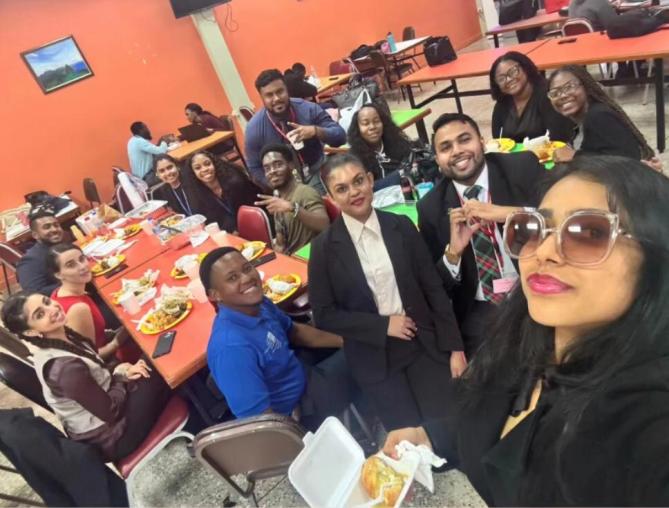
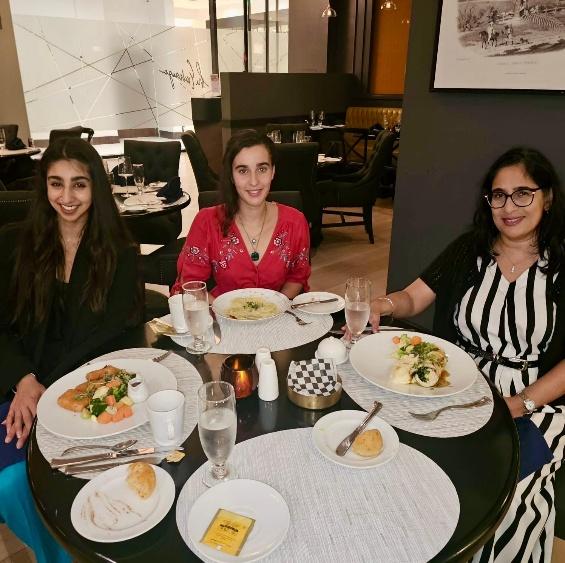
Afterwards, we dined with the students, enjoying amazing food from four different countries. During this dinner we were once again struck by the kindness of our hosts. The SRC then arranged for us to go up to Mount St Benedict’s where we admired the incredible views of Trinidad and received a brief talk from one of their priests on the origins of the church.
On Wednesday, we sat in Ms Gail Persad’s wills and probate class where we learnt about the various processes of state administration within Trinidad. Ms Persad taught us about the process to apply for both probate and letters of administration. This was something which we were both incredibly interested in as it was an area of the law which neither of us had yet studied in England. We were also fortunate enough to have the opportunity to shadow Ms Persad during a domestic violence hearing at the Trinidad and Tobago Magistrates’ Court. This was certainly an unforgettable experience! We were exposed through this hearing to the realities not just of the virtual Trinidadian court system but also to the realities of life as an advocate and a magistrate. We were inspired by Ms Persad’s professionalism throughout the hearing, and we were intrigued by the various orders open to domestic abuse survivors in Trinidad, many of which have a considerable overlap to those in our jurisdiction. After court, we were lucky enough to be taken to see the Hanuman Temple and the Temple on the Sea with Mr Ashok Balroop and Ms Lisa Ramjattan, who were amazing tour guides! On returning to school to attend our final class of the day with Ms. Renuka Rambajan, we learnt about case analysis and what a good case analysis looks like. Ms. Rambajan used anecdotes from her professional past to illustrate to us the importance of good ethics, reading the jury, and preparing for court. We picked up some valuable advocacy tips, and the traits that make a good lawyer.
On Thursday, we attended Ms Farah Ali Khan’s class where we learnt about the divorce process, and we were able to learn more about the specific forms which are required throughout the process. We reviewed the format of these forms, and the process of filing them in the high court of Trinidad. This class offered us meaningful insight into the procedural workings of the law. We were also afforded the opportunity to attend a court hearing for a contentious land matter between siblings, with Ms. Gail Persad and Mr. Jerome Herrera before Justice Kangaloo. Our final class of the day was with Ms. Zenobia Campbell-James. In this class, we were taught how to effectively draft an affidavit, a sworn evidence statement. Throughout the session, we reviewed different affidavit formats. Ms. Campbell-James highlighted that variations in style often reflect individual attorney preferences, but the essential element lies in the accuracy and clarity of the content. We both found this session engaging as neither of us had come across affidavits before in the English legal system and it was interesting to see how they were drafted and filed within Trinidadian legal proceedings. 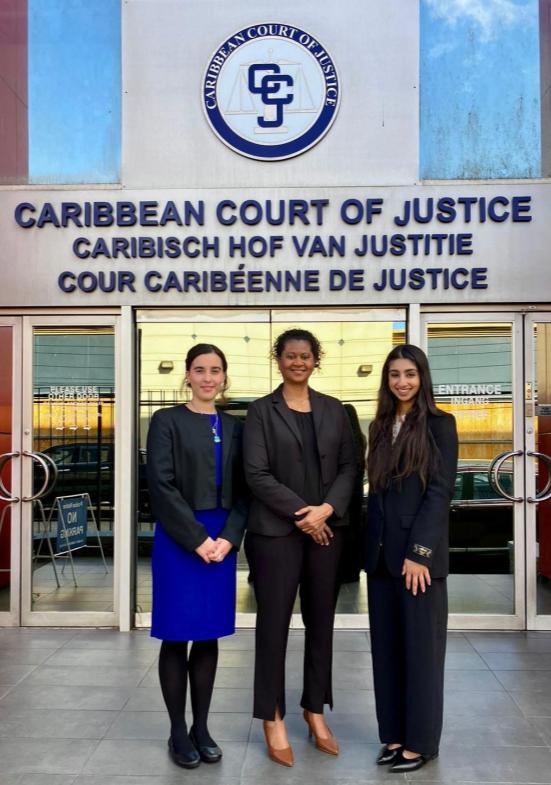
Friday came before we knew it. On our last day at Hugh Wooding, we were extremely fortunate that the law school had arranged for us to go for a tour of the Caribbean Court of Justice with Ms. Gail Persad. This was an incredible opportunity, and we both learnt a lot about the court’s jurisdiction. We were surprised to learn that although the court is based in Trinidad, it does not yet exercise jurisdiction as the final court of appeal. Trinidad continues to defer to the Privy Council, primarily because political approval for the transition has not yet been achieved. Whilst we were at the court, we were lucky enough to be able to also sit in on a hearing for the case of Ramsamooj v The State of Suriname. Ms Gail Persad was kind enough to explain to us the various positions of the individuals in the courtroom, and we had the honour of meeting Mr. Ramsamooj, the claimant, and his wife during a break in the proceedings. We were deeply moved by the generosity of Mr. Ramsamooj and his wife, who graciously shared the details of their case with us and responded openly to our questions, offering us a meaningful perspective on the real-world implications of the court’s decisions. After our illuminating court visit, we returned to Hugh Wooding to say our goodbyes to the staff and students.
We truly cannot express enough gratitude to everyone who made our journey so memorable. The generosity, kindness, support, and hospitality we received from both law schools deeply moved us. Throughout our trip, we created unforgettable memories and gained a profound understanding of Trinidad — not only of its legal system, but also of its rich and dynamic culture. We leave with a deep appreciation for the warmth of its people, the depth of its traditions, and the strength of its legal heritage. This experience has added an unforgettable chapter to our studies, and we have no doubt it will continue to shape our future careers.
Thank you so much to the HWLS and the QMLAC for granting us this incredible opportunity.
Rosabella Rajack and Renite Gosal