/filters:format(webp)/prod01/channel_262/queen-mary-university-of-london/media/qmul/research/Green-Dugs-(Test).png)
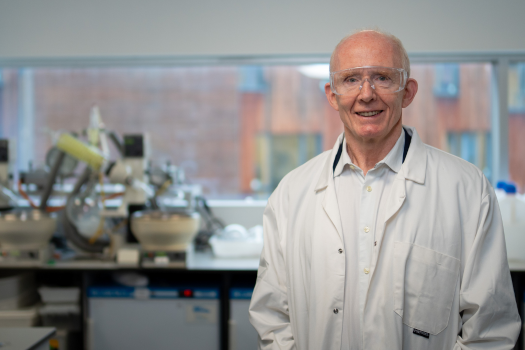
“At Queen Mary, we’re developing ultra-thin membrane filters to refine drug development and make it more sustainable.”— Professor Andrew Livingston
Queen Mary researchers are developing cleaner ways to make medicines
Chemical separations, a key part of pharmaceutical manufacturing, account for between 10-15% of global energy use. Traditional techniques like distillation and evaporation are especially energy- and solvent-intensive, driving high carbon dioxide emissions and contributing significantly to climate change and wider environmental impacts.
Led by Professor Andrew Livingston, Vice President for Research and Innovation and Professor of Chemical Engineering, Queen Mary researchers are developing new ways to carry out chemical separations that are more environmentally friendly.
They are developing ultra-thin polymer membranes – called ‘’molecular nano-sieves” – which can separate and purify liquid drugs without boiling. Working with industry partners AstraZeneca, Merck and Exactmer, and in collaboration with Imperial College London, the team are working to design ways to bring these ‘nano-sieves’ into membrane cascades that can be integrated directly into factory lines to recycle solvents and cut emissions. This novel, collaborative approach is more environmentally friendly yet still maintains high product purity and yield.
Professor Livingston’s research aims to ‘greenify’ the full membrane lifecycle – from reducing the use of harmful solvents and energy during membrane manufacturing, to designing longer-lasting, anti-fouling membranes that process more material before needing replacement. Taking this whole-system approach ensures that the environmental benefits gained during drug manufacturing outweigh the impacts of producing and disposing of the membranes themselves.
By cutting energy demand and enabling solvent recycling instead of single-use solvent disposal in pharmaceutical production, this work helps manufacturers lower the carbon footprint and wider negative environmental impacts of the medicines they produce. It also supports health systems such as the NHS, which increasingly require the medicines they procure to have lower environmental burdens in support of their net-zero goals, while ensuring drugs remain safe, reliable and effective. And over time, more efficient and less wasteful manufacturing processes like this could even help reduce costs for patients and taxpayers.
Key benefits of this research
- Less energy consumed, lower emissions
Reducing energy consumption by replacing energy-intensive boiling and distillation with membrane-based separations cuts carbon dioxide emissions from drug manufacturing. - Less solvent waste
Recycling and reusing solvents through membrane filtration reduces the need for fresh solvent production and disposal. - Greener healthcare supply chains
Helping pharmaceutical manufacturers reduce the environmental footprint of medicines supports health systems like the NHS in meeting net zero goals through lower-impact procurement.
/filters:format(webp)/prod01/channel_262/queen-mary-university-of-london/media/qmul/homepage/hero-campaign/Clearing-Whitechapel.jpg)
.png)