
Mel Ramasawmy- Co-designing videos to explain ‘large language models’ in healthcare and research
Large language models (LLMs) are a type of artificial intelligence which are being used more often in health care and research. Working with a group of PPIE contributors in Tower Hamlets, our research team co-created accessible resources to support the public to engage in LLM research and use them more safely.
Why do ‘Large Language Models’ matter?
Large language models (LLMs) are a type of artificial intelligence or ‘AI’. LLMs are being used more often in health care and research. For example, they may be used to communicate with patients, create records of consultations with a doctor, and predict risk of disease.
We know that when new technologies are introduced in healthcare not everyone benefits from them equally. In some cases, people might be harmed from unsafe use or the design not considering their needs.
We felt that it was important that the public have a good understanding of LLMs so that they can:
- Use LLMs safely as part of their health care and management
- Build trust in health services using LLMs
- Get involved in LLM research for health
Current videos that explain LLMs are very technical and the viewer needs to understand AI before watching. A team formed between Queen Mary University of London, King's College London, and Brighton and Sussex Medical School. We worked with a group of PPIE contributors with the help of Social Action for Health, to co-design information on LLMs that was accessible for everyone.
The co-design process
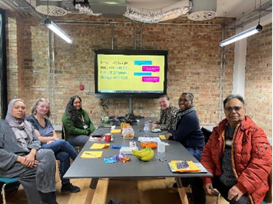
We started the work with six contributors from Tower Hamlets. During the first session, some of the group tried using LLMs for the first time. We designed games that mimicked how LLMs work, having a go at guessing patterns or completing sentences with the most likely word. We talked about what type of information the contributors felt it was important for people to know, and included this in a draft script. Over several workshops, we improved the script together. There was a lot of information to include, and the group suggested we split this into two videos: one introducing people to LLMs, and the second, focusing on LLMs in health and research.
We knew we wanted to make animations, rather than videos, as we felt this was the best way to show complicated or technical information. This gave us the chance to explore lots of ideas about how to explain how LLMs work. We did not want to describe LLMs as ‘understanding’ language, and the group came up with the idea of it being like a factory, that processes text in a predictable way. In the image below you can see how the idea went from a sketch, to a basic drawing, to the final product:

We tested the script and image ideas with a wider group of PPIE contributors and with other researchers, to make sure it made sense. We had the script and text on screen translated professionally, then improved it with a group of Bengali speakers. We worked with an animation company, Really Bright Media, who brought the ideas to life. The PPI contributors chose the voice actors, and gave feedback at three stages of the animation, to make sure the final product was what they were hoping for.
The benefits of co-design
As researchers, we might have our own ideas about what is important, or the best way to explain our subjects. The conversations with PPIE contributors helped challenge those ideas. They thought carefully about finding the right balance to not oversell LLMs or scare people who might be interested in them. Together, the group developed ideas about how to best to ‘show’, not just ‘tell’ when describing the potential risks and benefits of LLMs – and pointed out unintended consequences of using some examples – like when one version listed that people use LLMs to help with their homework! Working with the group made sure that the information was useful and clearly understandable.
The final products
Video 1: LLMs in General
This animation introduces viewers to how LLMs work and where they may encounter them in everyday situations. It covers both the potential benefits and the risks, giving people a balanced foundation for understanding these technologies.
Video 1: LLMs in General [Bengali]
Video 2: LLMs in Healthcare and Research
The second video focuses specifically on healthcare applications, showing how LLMs might be used by patients, clinicians, and researchers. It explains the potential benefits while being honest about the risks and limitations.
Video 2 - LLMs in Healthcare and Research
Video 2 - LLMs in Healthcare and Research [Bengali]
What happens next?
We see creating this video as the first step. We want the videos to be used to support people to have their say in health care and research that uses LLMs. Our plan is to:
- Engage with communities: We held a public screening in Tower Hamlets, where the PPIE members, other researchers and members of the public joined to watch the animated videos.
- Distribute the videos: We will be sharing these videos on social media platforms and within our organisations.
- Extend access to other languages: We have translated the videos into Bengali, the most common non-English language in Tower Hamlets. We plan to translate it into other languages too.
- Sharing our experiences: Three of our PPIE contributors presented our work at the HealTAC conference 2025. We will be publishing our training materials and experiences so other researchers can replicate this approach.
-----------
This work was funded by the Centre for Public Engagement Participatory Research Grant, Queen Mary University of London, and the Public Engagement Small Grant from King’s College London. Additional funding and support for the work was provided by: Social Action for Health, Wellcome, and the AI-Multiply project (NIHR), and colleagues at Brighton and Sussex Medical School. The animations were developed by Really Bright Media.