
Seven paradoxes of prostate specific antigen (PSA) testing and what they mean for screening
What if a screening test could miss cancers, and that was actually a good thing? In this blog, Dr Adam Brentnall unpacks seven paradoxes of PSA testing and explores why a smarter, more targeted approach could improve prostate cancer screening and save more lives.
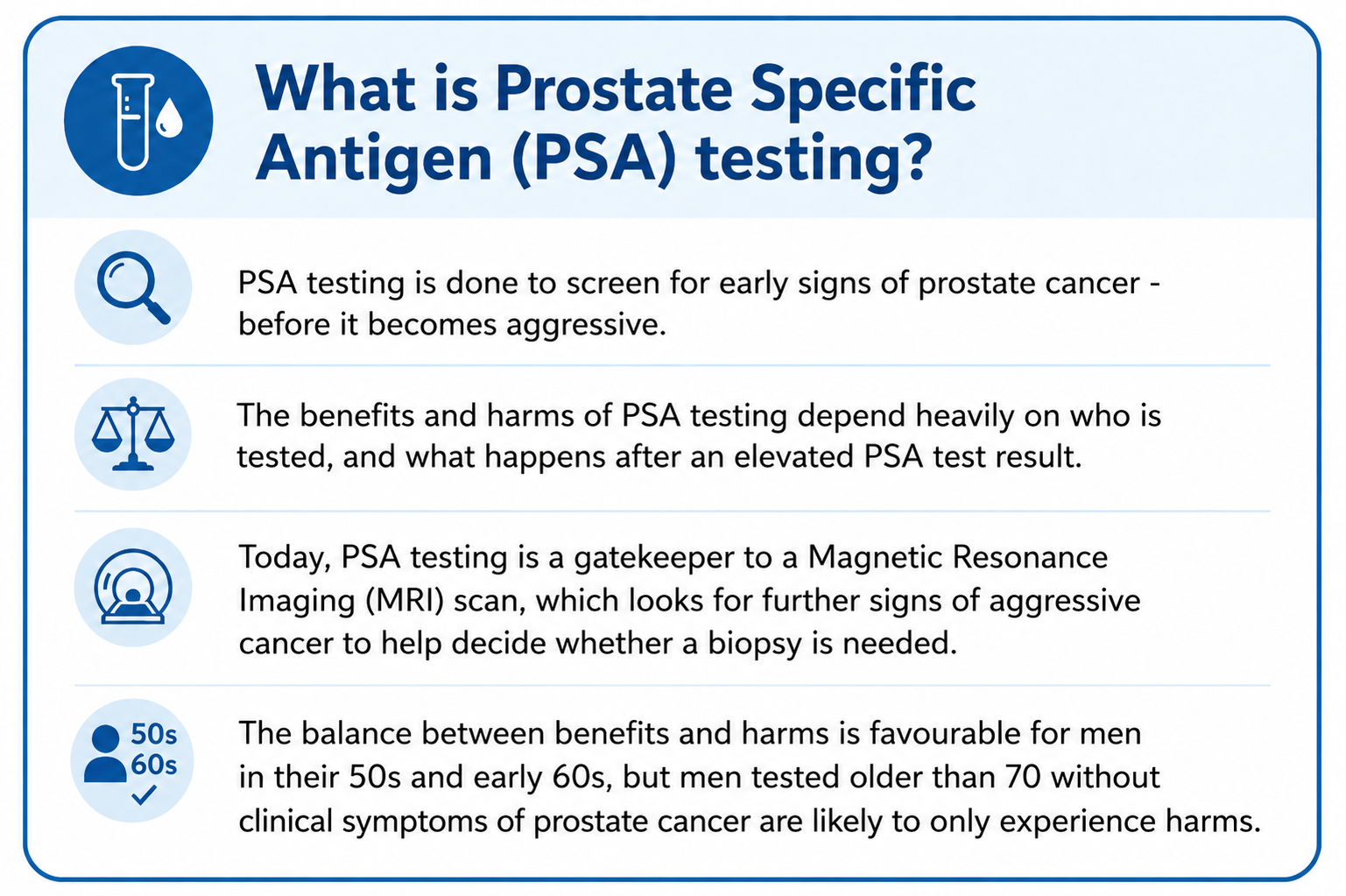
Prostate cancer screening has a complex balance of benefits and harms. There is currently no organized prostate cancer screening programme in the UK, but any man over the age of 50 can request a PSA test from their GP when they want.
In this blog we consider several paradoxes of PSA testing and what they mean for screening.
About the author
Dr Adam Brentnall is a cancer screening researcher whose work focuses on risk-stratified screening and the early detection of cancer. He has also recently been appointed to Head of Statistics of our Cancer Prevention Trials Unit.
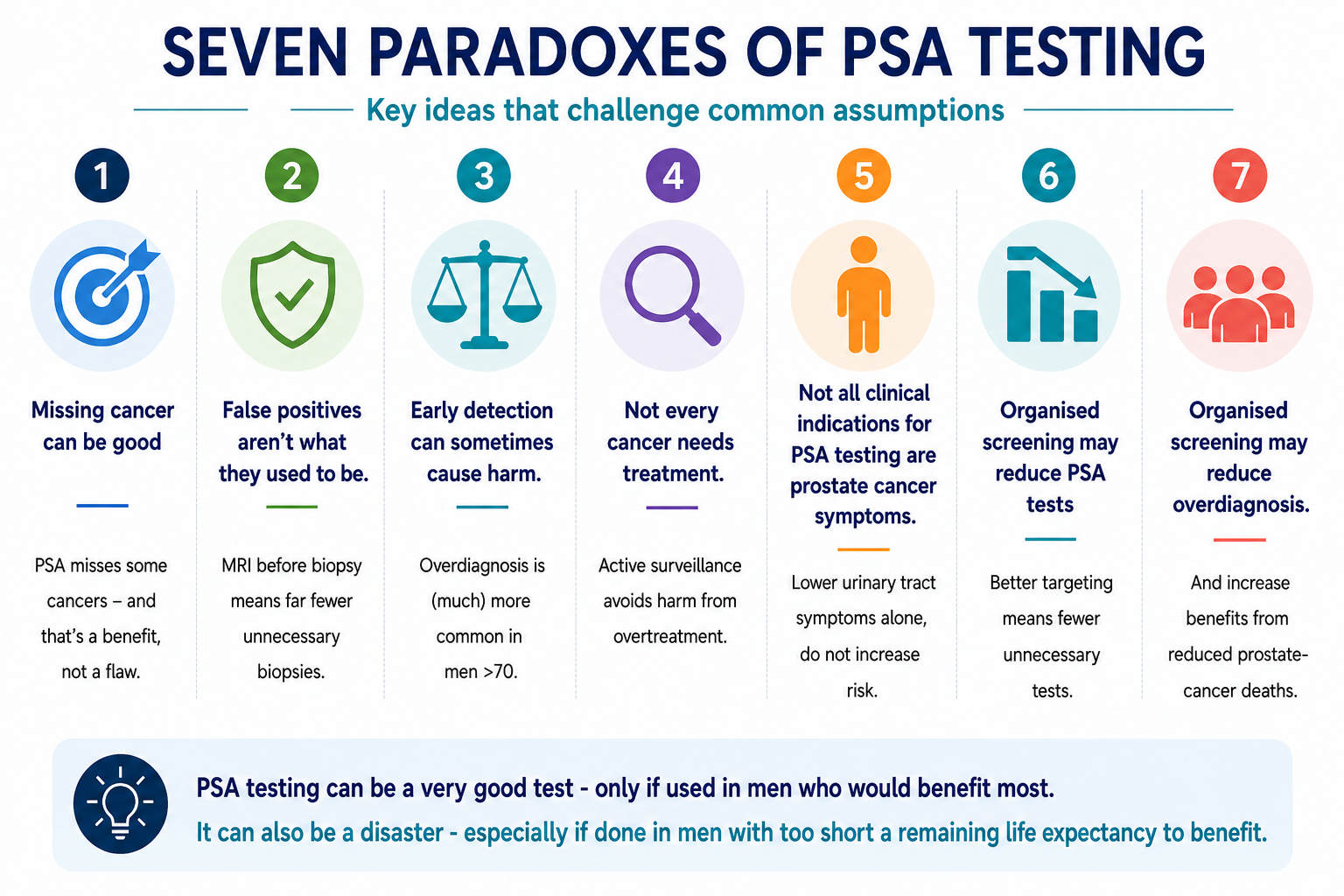
Paradox 1. PSA misses a lot of cancer - which is a benefit not a flaw
One often-cited study found that a very high 15% of men with a "low" PSA still had prostate cancer when biopsied. It might appear concerning that PSA tests may miss so many men with prostate cancer.
Surprisingly, this is not a problem - and is actually a benefit of PSA testing in younger men.
The reason is most men will develop some form of prostate cancer if they live long enough, but the majority will die with it, not because of it. A good screening test should avoid detecting harmless cancers that would never have caused a problem. PSA helps to do exactly that, so this is actually a point in its favour, not against it. Research has consistently shown that people with high PSA values are much more likely to get distant metastases and to die from prostate cancer, if it is not picked up early. Conversely, those in the population with low PSA are very unlikely to die from prostate cancer. In other words, the cancers identified by PSA are often the very cancers most worth finding.
Paradox 2. Many people without cancer have high PSA - but false-positive rates at biopsy are low
A common criticism of PSA testing is not being “specific” to prostate cancer. Benign conditions such as prostate enlargement and inflammation can also raise PSA levels, meaning some men will have an abnormal result despite not having cancer. PSA can also be raised for other reasons, unrelated to any disease - one reason why doctors recommend repeating PSA testing before doing anything else (although note that you don’t need a ‘finger up the bum’ to detect prostate cancer).
The lack of specificity to cancer used to be a problem because men used to be quickly biopsied straight after an increased PSA. This was a problem because biopsies themselves cause harm, such as infection, bleeding and unnecessary anxiety.
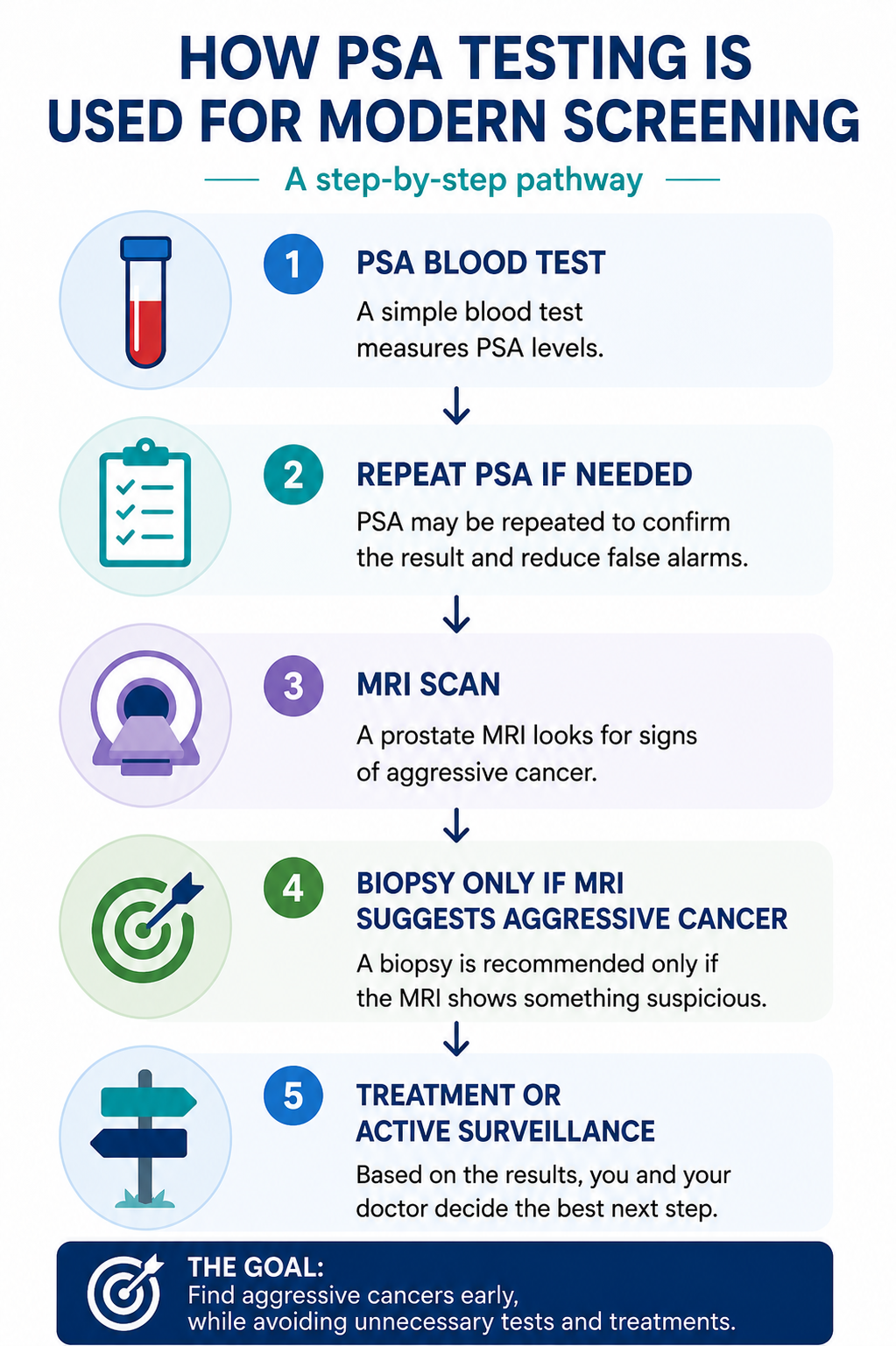
To minimise this issue the screening pathway has been improved. Men now have a magnetic resonance imaging (MRI) scan after their PSA test(s), and before biopsy. Today a higher proportion of biopsies detect prostate cancer rather than benign disease. The biopsy procedures also have fewer harms than before, almost eliminating infections.
PSA for screening is not a diagnostic test – it is a first step along the screening pathway. It should not be judged as if it were a definitive diagnostic test. What matters to men being screened is how well the full screening pathway works. There are now few false positives at biopsy.
Paradox 3. Early detection of prostate cancer can do more harm than good
Overdiagnosis is detection of cancer that would never have been found in a man's lifetime, if it wasn’t for the PSA test. It is often raised as the main problem with PSA testing. But it is mostly an issue affecting testing in older men.
Many prostate cancers have what epidemiologists call a long “sojourn” time. This is the period in which they are detectable by PSA screening, but before they have grown large enough to cause problems. This is good because it means there is a “window of opportunity” to catch the cancer early. But, counterintuitively, for some, catching the cancer early only leads to harm.
Overdiagnosis happens when a cancer is detected in this window of opportunity, but unfortunately the man dies from something else soon after diagnosis – also in the "window of opportunity”.
Therefore, PSA testing needs to be done, only in those with sufficiently long remaining life expectancy. Fortunately, we can anticipate this quite well. For instance, there is clearly no need to screen centenarians because they are almost certain to die in the “window of opportunity”.
This means that the real issue with overdiagnosis isn’t with the PSA test but how it is used. PSA mainly causes overdiagnosis in older men, which is why some international guidelines recommend screening for men only in their 50s and 60s. So if a man decides to have frequent PSA testing that continues into old age, then he is more likely to be harmed than to benefit.
A related issue is that there comes a point when PSA testing needs to stop.
This is because for men older than 70 years at screening, screening offers very little, if any, benefit, but carries a high risk of unnecessary harm from overdiagnosis. Similarly, men with comorbidities younger than 70 years are also less likely to benefit from screening.
It also turns out that the results from PSA testing are very informative on deciding when to stop testing otherwise healthy men younger than 70. For instance, a European consensus PSA screening algorithm recommends that men in their 60s with PSA < 1ng/ml can safely stop PSA testing. However, due to the lack of a formal screening program, few men being tested in the UK today know or act on their PSA results in this manner.
Paradox 4. Rushing to treat some cancers can do more harm than good
In the past men with low-risk disease (based on the cancer pathology from a biopsy) were rushed to surgery, or at least rushed to make decisions about their treatment. But we now know that this is not always needed.
Today doctors recommend to monitor such cases to see if the prostate cancer progresses. They only recommend treatment when there is evidence that it has become dangerous. This “active surveillance” is now also being done with PSA and MRI monitoring. Evidence supports the safety of this approach, and it is accepted by many men.
It is worth noting that this approach also has a complex balance of harms and benefits. For instance, active surveillance may act as a safety net against potential harms from overdiagnosis, but may also medicalise a man for longer than would be necessary without screening. This is partly why research on biomarkers to better stratify prognosis of men with low-risk cancer is important.
If interested in learning more about active surveillance you may find The Active Surveillor, a newsletter by medical journalist Howard Wolinsky, a useful resource. It provides news, commentary and discussion on active surveillance for low-risk prostate cancer
Paradox 5. Men with certain clinical-guideline “symptoms” of prostate cancer are not at increased risk of aggressive prostate cancer
Men in the UK today are currently tested either because they are concerned about their risk and request a test from their GP; or because they have "symptoms" of prostate cancer, as defined by clinical guidelines.
These indications include lower urinary tract symptoms (LUTS), which are very common in older men. Surprisingly, however, LUTS are not associated with an increased risk of prostate cancer, i.e. LUTS are not caused by prostate cancer.
This is not really a paradox, but an issue with current clinical guidelines.
Regardless, what it means is that the same considerations on the benefits and harms of PSA testing apply to these men, as to those without such "symptoms". Effectively, PSA testing in these men is screening, and, for example, age is critical to the potential benefits and harms of PSA testing in men with LUTS.
Paradox 6. An English national program could reduce the number of PSA tests
Recent research that I undertook with colleagues used statistical modeling to determine the effect of implementing population-based prostate-specific antigen (PSA) screening in England on overdiagnosis and PSA testing rates, in comparison with the current opportunistic testing policy. Surprisingly, other models have not considered this.
The model merged English data on life expectancy, rates of PSA testing and incidence of prostate cancer by stage, with epidemiological data on how long the “window of opportunity” for catching cancer early is for prostate cancer.
The analysis found that currently in England most PSA testing occurs in men older than 70 years, and of those men tested, many have repeat tests. The model showed that targeting PSA testing to younger men, with limited repeated testing, could lead to no more PSA tests being done than at present.
The reason is simply that the increase in PSA tests done in younger men in their 50s through an organised programme, could be more than offset by design through decreased testing in older men.
Paradox 7. An English national screening programme could reduce overdiagnosis
It might appear paradoxical that implementing a population-based screening programme to provide PSA tests would reduce overdiagnosis (the detection of prostate cancer that would not have arisen in a man's lifetime otherwise).
However, it is logical that a rational call/recall programme specifically designed to reduce overdiagnosis would have better outcomes than the testing activity taking place today – where a man can get a PSA if he asks for one, even if he has too short a life expectancy to benefit.
The modelling results arise from an assumption that a rational, national programme would deliberately give PSA tests to those who are most likely to benefit and withdraw them from those who are likely to only be harmed by their use. The small increase in overdiagnosis from PSA testing for men in their 50s would likely be more than offset by a reduction in PSA tests in men older than 70 years. This also happened in Lithuania when they implemented organised screening.
What does this mean for PSA testing?
PSA testing can be a disaster - if used badly.
If you give PSA tests to older men without symptoms associated with increased risk of aggressive cancer, then rush to biopsy if the PSA is high and treat any cancer you find, it is pretty clear from a public health perspective that PSA testing will do more harm than good. Nonetheless, it is worth noting that when PSA testing is used badly (such as due to public health policies), it is unlikely that this will be immediately obvious to those tested and diagnosed with prostate cancer.
PSA can also be a very good test - if used wisely.
If, instead, you use PSA in younger men, don’t worry about finding every cancer but focus only on the ones likely to become aggressive (that PSA testing is more likely to find), do additional triage tests like MRI before suggesting a man has biopsy and only treat aggressive cancers, then there is little doubt that PSA testing will reduce cancer deaths, without causing significant overdiagnosis and associated harms. Indeed, high-quality randomised trials show that finding cancer through prostate cancer screening reduces the number of cancer deaths, and that overdiagnosis is low in younger men.
PSA testing has fallen short in practice.
This is not because the test itself is flawed - but how it is used. PSA testing today is mostly offered informally, on request, without a structured programme and evidence-based clinical guidelines to back it up and make sure the process is done wisely. Millions of men have been tested in this way in the UK alone. This disorganised approach has led to PSA testing being used in a bad way. This has led to real harm – that is widely underappreciated - particularly regarding high levels of testing in older men.
Conclusion
There is a scientific argument that moving towards population-based prostate screening is justified, and, concurrently, access to opportunistic PSA testing should be stopped. This is accepted by policymakers in the European Union.
Others, including the UK National Screening committee, have judged that organised screening is not justified, at least not yet. Nonetheless, it is clear that population health would be better served by starting to use PSA testing more wisely.
Arguably, the best way would be to move towards an organised, population-based prostate screening programme. This would be unlikely to importantly increase PSA testing and overdiagnosis in comparison with current NHS policies and guidelines on PSA testing. Indeed, such a program would most likely improve informed decision making about PSA testing, reduce the harms, and increase benefits.
In the absence of such a program, reform of the current system is warranted. This includes updating the Department of Health's "Prostate Cancer Risk Management Programme", and associated clinical guidance, which are responsible for how PSA testing is used today. Some potential changes to these will be discussed in a later blog.
What should readers take away?
- The balance of benefits and harms from PSA testing depends on who is tested, at what age they are tested, how often they are tested, and what happens after an abnormal result.
- Modern pathways using MRI and active surveillance can reduce unnecessary biopsies and treatment.
- Older men are more likely to experience harms from overdiagnosis, while younger men are more likely to benefit from early detection.
- Organised screening is likely to achieve a much better balance of benefits and harms than the current NHS policy that enables widespread opportunistic testing in older men.
"Much of this blog was inspired by joint work with Andrew Vickers, Matejka Rebolj, Peter Sasieni, Rhian Gabe, and Garth Funston; but any errors are my own!"
Acknowledgement
We are grateful to Andrew Boyle, a member of our Patient and Public Involvement (PPI) panel, for reviewing this blog and providing insightful comments and editorial suggestions that helped improve its clarity and accessibility.
Conflicts of interest
Dr Adam Brentnall is a member of the UK National Screening Committee Research and Methodology Group. He is a co-investigator on the TRANSFORM prostate cancer screening trial and co-PI on the AVIDITY prostate cancer imaging study. He receives research funding from Prostate Cancer UK, Cancer Research UK, the National Institute for Health and Care Research (NIHR), Breast Cancer Now and Barts Charity. His research includes work on prostate cancer detection using artificial intelligence.
Enjoyed this article? Subscribe to our blog to receive updates when we publish new posts on cancer screening, prevention and early diagnosis