
TRANSFORM: a new era for prostate cancer screening
Why don’t we screen for prostate cancer? and could we be on the verge of changing that?
Despite being the most common cancer in men in the UK, there is still no national screening programme. Previous approaches found too many cancers that would never have caused harm, leading to unnecessary tests and treatment. Now, advances in MRI and genetic risk assessment could change the future of prostate cancer screening. The TRANSFORM trial is exploring whether we can find the cancers that matter, save lives, and reduce unnecessary harm.
By Professor Rhian Gabe
Rhian Gabe is Professor of Clinical Trials and Biostatistics, Director of the Barts Clinical Trials Unit, and Co-Director of the Cancer Prevention Trials Unit (CPTU) at Queen Mary University of London. With more than 30 years of experience in designing and evaluating clinical trials, her research focuses on cancer prevention, early detection and screening.
Rhian co-leads the TRANSFORM trial, funded by Prostate Cancer UK and the National Institute for Health and Care Research (NIHR), which is evaluating new approaches to prostate cancer screening. She also co-leads the Cancer Research UK-funded PACIFIC trial, which is exploring innovative MRI technologies to improve prostate cancer detection, and is the statistical lead for the Yorkshire Lung Screening Trial.
Every year, thousands of men are diagnosed with prostate cancer. Yet unlike breast and cervical cancer, there is still no national screening programme in the UK. Why? And could new technologies finally change that? The TRANSFORM trial is exploring whether advances such as multiparametric MRI (mpMRI) and genetic risk assessment could make prostate cancer screening more accurate, helping to find cancers that need treatment while keeping potential harms to a minimum.
At a glance...
- There is currently no national screening programme for prostate cancer in the UK because there is not yet enough evidence that a screening programme using modern tests, such as MRI, would improve outcomes, be cost-effective, and avoid unnecessary diagnosis and treatment. The TRANSFORM trial aims to provide the evidence needed to answer these questions.
- New technologies, including special types of MRI and genetic risk assessment, could change how we detect prostate cancer. These advances could make screening more accurate, reduce unnecessary treatment, and provide the evidence needed to support a national screening programme.

- TRANSFORM is comparing different screening approaches to find out which strategy achieves the best balance between reducing prostate cancer deaths while providing value for money for the healthcare system.
The bad old days
For many years, the main approach considered for prostate cancer detection relied on a simple pathway: men with a raised prostate-specific antigen (PSA) level would be offered a biopsy. Randomised controlled trials in the UK, US and Europe based on this pathway did not support a policy of screening for prostate cancer with a perceived, unacceptable level of harms to benefits.
The main challenge with the approach was overdiagnosis. Overdiagnosis is the detection of cancer that would never have been found in a man's lifetime, if it wasn’t for the PSA test. These slow-growing cancers would not have progressed to cause problems before a man died from something else.
Before MRI was introduced to the pathway, many men underwent unnecessary biopsies following raised PSA results. For men who were overdiagnosed, the diagnosis itself could cause anxiety and, in some cases, lead to treatment that offered no benefit. This ‘overtreatment’ could cause lifelong side effects, including urinary incontinence and erectile dysfunction, while also increasing demands on healthcare resources.
Why do we have breast but not prostate cancer screening?
Although MRI has transformed how prostate cancer is investigated, there is still insufficient evidence that these newer approaches would make a national screening programme effective, safe and cost-effective. The UK National Screening Committee has reviewed the latest evidence but concluded that important uncertainties remain.
Filling these evidence gaps is exactly what the TRANSFORM trial is designed to do. This is particularly important for Black men, who are at higher risk of developing and dying from prostate cancer but for whom evidence on the best screening approach remains limited.
In contrast, there is established long-term evidence from trials as far back as 1963 that screening using mammography can reduce deaths from breast cancer. Although the PSA test has existed for many years, we lacked a reliable way of looking inside the prostate to identify which men were most likely to have clinically important cancer. The prostate is much harder to image than the breast, and it is only recent advances in MRI technology that have made this possible.
New tools
A newer type of MRI scan, called Multi-parametric MRI (mpMRI), can look inside the prostate and identify areas that are more likely to contain clinically important cancer. Following evidence from the PROMIS and PRECISION trials, UK guidance changed in 2019 recommending mpMRI as a standard check before prostate biopsy to help decide whether a biopsy is necessary in men with raised PSA (NICE guidance 2019). These trials showed that mpMRI detects more clinically significant prostate cancer amenable to treatment, less low risk disease unlikely to cause harm and that men with a negative MRI scan could safely avoid invasive, uncomfortable biopsies that also carry a small risk of sepsis. Although this seems promising, it has yet to be confirmed whether these important benefits associated with MRI hold in a screening context where the primary aim is to reduce prostate cancer deaths.
In parallel, work on genetic risk profiling has led to several promising polygenic risk scores (PRS) that could also improve a prostate cancer screening pathway. PRS use information from a person’s DNA to estimate their inherited risk of developing prostate cancer.
What is the best way to screen for prostate cancer?
While it seems clear that a stepped (also known as ‘risk-stratified’) approach to screening and diagnosis is needed, we are unsure what the best combination of these new promising tests should be.
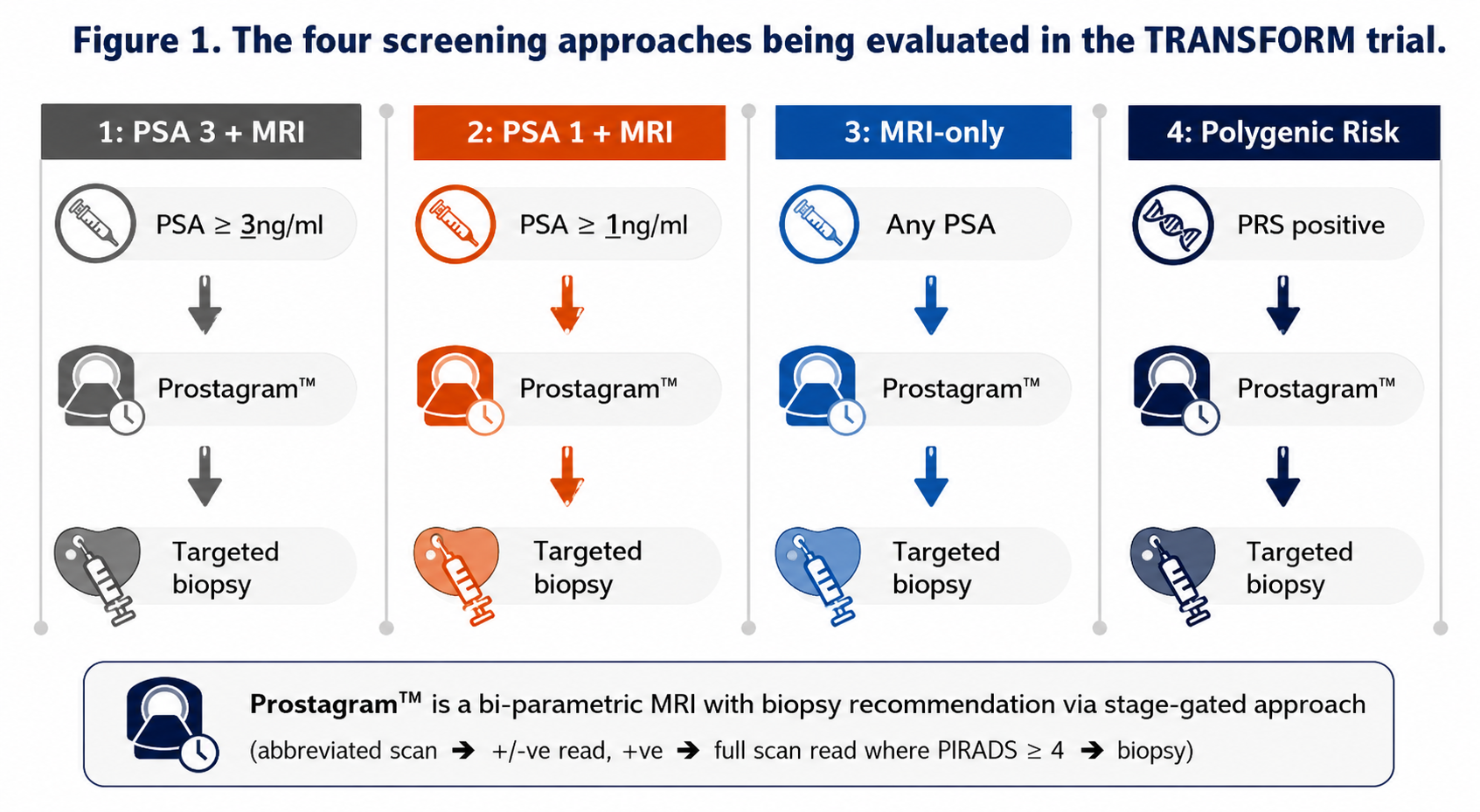
The TRANSFORM trial is currently testing four different approaches to prostate cancer screening. The first stage of TRANSFORM is comparing four different approaches to prostate cancer screening. Two strategies use different PSA thresholds before MRI (≥3 ng/ml and ≥1 ng/ml), one offers MRI to all participants regardless of PSA level, and one uses a polygenic risk score (PRS) to identify men for MRI. In all four approaches, men with suspicious MRI findings are offered a targeted biopsy. The results will help identify which strategy has the greatest potential to support a safe, effective and equitable national prostate cancer screening programme (see Figure 1).
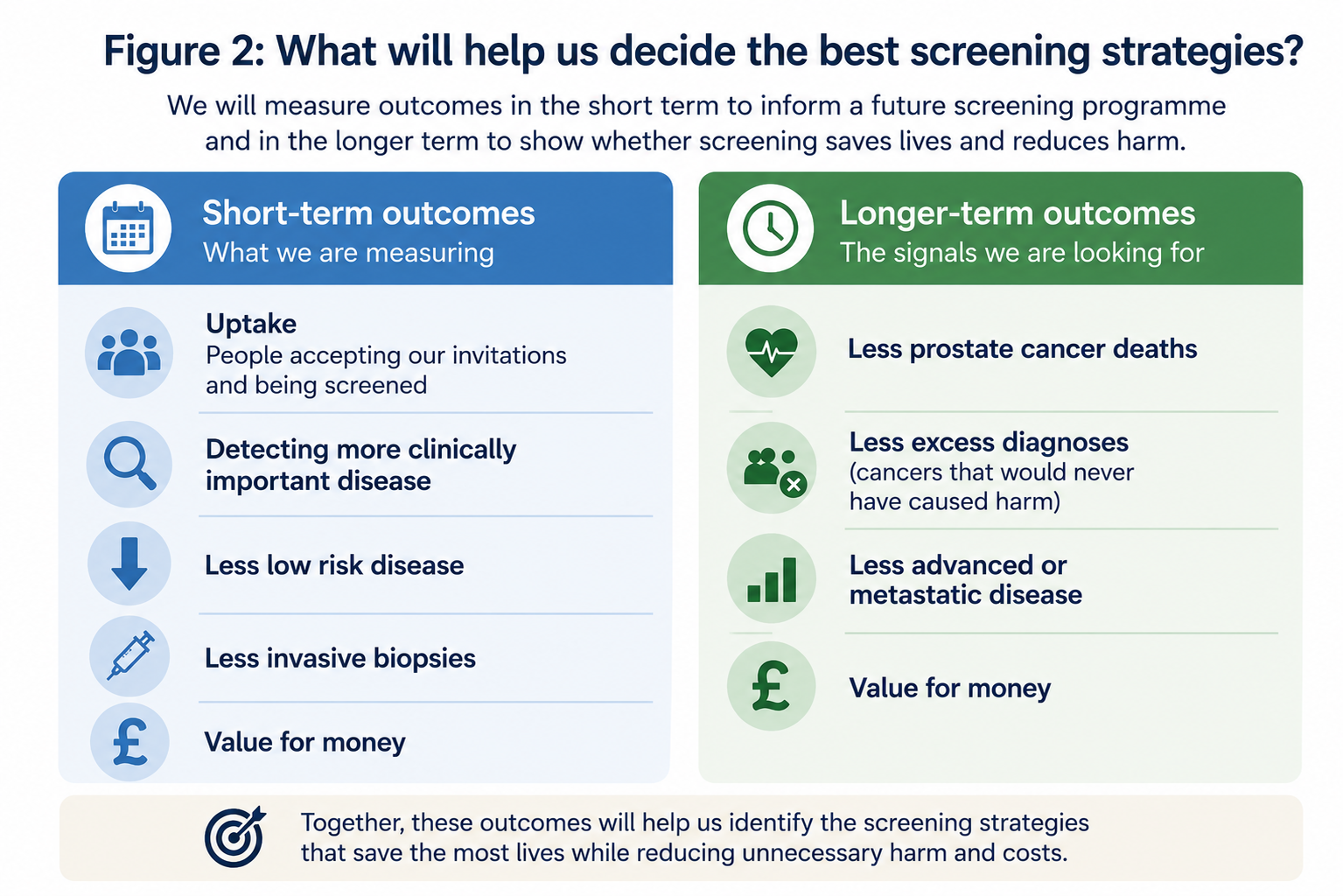
In this first stage of TRANSFORM, we intend to measure short-term outcomes that would inform the success of a future screening programme as well as an optimally designed long-term trial to provide definitive evidence with respect to prostate cancer deaths and harms (see Figure 2).
TRANSFORM for who?
TRANSFORM aims to generate the evidence needed to inform a future national prostate cancer screening programme. The trial includes men aged 50–75 years from the general population, alongside a targeted approach for Black men aged 45–75 years, who are at higher risk of developing prostate cancer.
Black men are more likely to develop prostate cancer, to be diagnosed at a younger age, and to present with more advanced disease. However, evidence on the best screening approach for this group is limited. TRANSFORM provides an important opportunity to address this gap.
Men with a family history: TRANSFORM will ask all men invited if they have a family history of prostate cancer to provide evidence on this in those aged 50-75 years. We are unable to invite men with a family history at lower ages because family history is mostly missing from records used to identify men, such as GP records. Looking ahead, improving the recording of family history in electronic health records, and better defining what constitutes a sufficiently strong family history for screening, will be important steps towards future risk-based screening programmes.

Why is screening so difficult?
Large studies are challenging and it is important to critically review and address these challenges to help us improve our research. No one solution is perfect but given we have these promising new technologies, it is important to progress.
- Will enough men take part?
Not everyone accepts invitations to be screened for cancer due to varied and multiple reasons: lack of time, accessibility, understanding, belief, anxiety/fear or stigma. We have an expert team who advise on the way we invite people and their work is informed by public-patient involvement and engagement with groups at risk. Our initial tests involve taking blood or saliva samples, or scans (and not a digital rectal exam). Low uptake would mean we are unable to differentiate the best strategies and demonstrate a reduction in prostate cancer deaths.
- Why does the trial need to be so long?
Waiting 16 years to demonstrate a reduction in prostate cancer deaths does seem like a long-time (cancer prevention can be a long game). Doing nothing because it takes a long time is not an option and our research will help us learn along the way. Our shorter-term results will better inform prediction models and there is ongoing research for efficient methods we could adopt as well as the potential to measure novel biomarkers for prostate cancer death and metastases.
- What happens as new technologies emerge?
TRANSFORM will be adaptive and able to incorporate promising new technologies.
- How do we ensure screening is equitable?
An organised prostate cancer screening programme inviting all men at risk and using the best technologies is more equitable than opportunistic testing where the onus on men is to seek out the PSA test themselves. Further disadvantages of opportunistic PSA testing include overdiagnosis, especially in older men less likely to derive benefit in terms of extending life (see our previous work for details). Research also tells us that there are ethnic and societal barriers to accessing care and cancer tests. Moreover, Black men are at higher risk and there is a lack of evidence to inform policy because black men have not been previously well represented in our studies. The recently announced investment in TRANSFORM to invite all Black men is driven by the motivation to overcome these barriers. Increasing the scale and reliability of our evidence will benefit all men at risk. The TRANSFORM team are working closely with Black communities and other health advocates, charities and groups across the UK to ensure the offer of screening is made as easy as possible for participation in TRANSFORM and to be prepared for a future screening programme.
Conclusion
High quality trial evidence is needed to inform the policy of prostate cancer screening. TRANSFORM provides the opportunity to generate that evidence by evaluating new technologies and screening strategies at a national scale.
The UK is particularly well placed to answer this important question having led the way scientifically for use of MRI in the current prostate cancer detection pathway. Through its established healthcare infrastructure, research expertise, and ability to deliver large-scale population studies, the UK has the opportunity to lead the way in understanding whether a more effective and equitable approach to prostate cancer screening is possible.
Importantly, this includes addressing inequalities in prostate cancer outcomes. Black men are at higher risk of developing and dying from prostate cancer, yet evidence on the best screening approaches for this group remains limited. Recent investment to expand TRANSFORM will help ensure that more Black men are represented within the trial and that their needs are considered when developing future screening strategies.
The question is no longer simply whether we can detect prostate cancer earlier; it is whether we can do so in a way that saves lives while minimising unnecessary harm. TRANSFORM aims to provide the evidence needed to answer that question and help shape the future of prostate cancer screening.
Enjoyed this article? Subscribe to our blog to receive updates when we publish new posts on cancer screening, prevention and early diagnosis.