
Our Research
Our research includes the following main themes:
- Developing and evaluating biopsychosocial interventions to support mental health and wellbeing
- Improving access to mental health support among ethnic minority groups, particularly South Asian Communities
- Exploring risk factors and health inequalities for mental health conditions and physical comorbidities
- Community arts approaches and arts-based methods
- Global mental health
- User involvement, coproduction and participatory approaches
All of our current research projects are listed below:
Active Research Projects
Atmiyata East London
A collaboration between QMUL, Newham Community Project, the London Borough of Newham, and the Centre for Mental Health Law and Policy in India, funded by Barts Charity. The project aims to adapt and pilot an evidence-based community-led mental health programme called "Atmiyata" that has been proven to reduce symptoms of common mental disorder and improve quality of life in Gujarat, for the context of Newham. At the heart of Atmiyata are local volunteers trained to provide low-intensity mental health support for people experiencing distress, depression or anxiety including raising awareness about psychological distress, helping people to access local support, and referring people to mental health services if needed. Over three years we will adapt, pilot and evaluate Atmiyata in the Green Street neighbourhood with support from the East London NHS Foundation Trust.
Augmented Social Play (ASP-Belong)

A collaboration between 11 partner organisations across 6 countries, spanning universities, technology companies, and creative industries, funded by Horizon Europe and UKRI. The project aims to develop, evaluate, and implement LINA, a smartphone-enabled group intervention that boosts adolescent mental health by supporting real-world connection and sense of belonging in school settings. At the heart of LINA is a combination of immersive storytelling, augmented reality, collaborative gameplay, and evidence-based psychotherapeutic techniques. Working across academia, industry, education, and the arts, and in close collaboration with young people, the project is evaluating LINA through a multi-country cluster randomised controlled trial across secondary schools in the Czech Republic, Portugal, and the UK to generate robust evidence to support adoption by policymakers, practitioners, and schools at scale. QMUL coordinates Work Package 3 of ASP-Belong overseeing the design and delivery of the ASP#1 LINA trial across all three countries.
The Brown is Beautiful Project
 In 2017, the government recommended that school-based Mental Health Support Teams (MHSTs) deliver targeted, cognitive dissonance-based group interventions to teenage girls to discuss how they think and feel about their appearance, to try and stop them from developing body dissatisfaction and subsequently eating disorders. The most widely evaluated intervention of this type is ‘The Body Project’. However, in the UK, young people want to discuss more diverse appearances in these groups. This research builds on recommendations which were co-developed as part of 'The Body Image and Ethnicity Study' by co-designing ‘The Brown is Beautiful Project’ and an accompanying intervention support toolkit (IST) with experts-by-experience. A pilot trial will evaluate the feasibility, acceptability and efficacy of this intervention in East London schools. In addition to traditional routes of impact, we will work with key stakeholders to establish a Community of Practice so that The Body Project and other school-based body image interventions can be delivered by MHSTs in a culturally accessible way.

Funded by an NIHR Three Schools Postdoctoral Fellowship, this project aims to strengthen alcohol prevention and treatment for underserved groups. Working collaboratively with community members, people with lived experience, and service providers, the project aims to develop culturally appropriate staff training and tailored resources for South Asian communities. By prioritising lived experience and cultural insight, it seeks to improve the effectiveness, accessibility, and equity of alcohol-related support services.
ICONIC is a 5-year NIHR funded research programme coordinated by the Unit for Adult Mental Health and Wellbeing, QMUL and sponsored by East London NHS Foundation Trust. The programme aims to improve quality of life (QoL) and behaviour that challenges in people with mild to moderate learning disability, through DIALOG+, an evidence based, face-to-face intervention delivered by health professionals using a tablet. DIALOG+ structures routine care sessions to ensure that care planning is personalised, holistic and co-produced. We want to make DIALOG+ accessible and suitable for people with learning disability to help individuals think about things in their life they want to improve (e.g. access leisure activities, support with accommodation) by using resources available to them or their carers. Our aim is to test if it improves quality of life and behaviour.
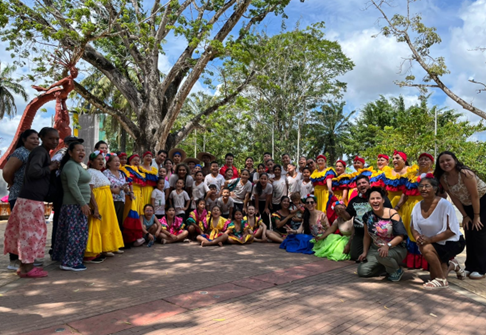
The NIHR Global Health Research Centre for Non-Communicable Diseases in Latin America is a collaborative initiative between QMUL, Universidad Javeriana (Colombia), Universidad Franz Tamayo (Bolivia), and Universidad Rafael Landívar (Guatemala). Together, these institutions form a regional hub for research, training, community engagement, capacity building and collaboration. The Centre works to improve community-based care for people living with long-term health conditions across the region though cultural, community-based interventions and innovation in research. It focuses on strengthening how health systems support people with conditions such as diabetes, cardiovascular disease, respiratory illnesses, and mental health problems, particularly within underserved and indigenous communities. Through postgraduate training programmes, research opportunities, and regional partnerships, the Centre is supporting the next generation of researchers and health professionals. It also works closely with communities, healthcare providers, and policymakers to ensure that research is relevant, inclusive, and impactful.
This NIHR mixed-methods project aims to understand the treatment of depression in South Asian patients, with specific reference to factors affecting appropriate antidepressant prescribing in this patient group. The secondary aim is to understand the intersection between ethnicity, age and financial deprivation within this context. The project will i) estimate the prevalence and heterogeneity of depressive symptoms and antidepressant prescribing among minority ethnic individuals in the UK, ii) explore the presentation of depression in South Asians and if existing depression screening tools in primary care are culturally competent and iii) identify aspects of the consultation that affect antidepressant prescribing at the point of diagnosis/first-ever antidepressant prescription among South Asian patients.
Scoping the Evidence on Antipsychotic Discontinuation and Dose reduction

Funded by an NIHR School for Primary Care Research grant we aim to scope out the existing literature and guidance to determine the strength and types of evidence on who might be able to stop antipsychotic medications with a lower chance of relapse for people diagnosed with a psychotic illness (e.g. schizophrenia or bipolar disorder). Our aim is for the findings to help patients and professionals to feel more confident in having conversations about when to consider stopping antipsychotic medications, and when not to.
SUPREME Study: Social prescribing and Severe Mental Illness (SMI)
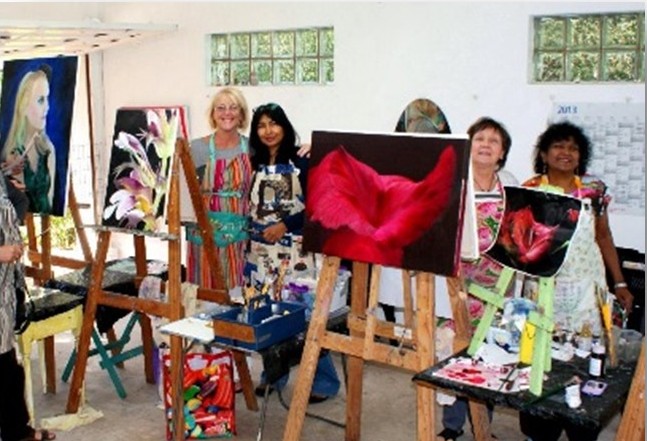
This MQ funded mixed-methods project aims to understand whether social prescribing is reaching people with SMI through primary care, what the potential barriers and facilitators to access are and to develop a training programme for link workers to build confidence and work more effectively with this population. The acceptability, feasibility and impact of social prescribing for people with SMI will also be explored.
TMS Depression Study
.png)
Predicting Response To Sleep Deprivation and rTMS Treatment For Depression: An AI/ML-guided Assessment Tool: This Barts Charity funded project explores how people with treatment-resistant depression respond to novel treatments such as repetitive Transcranial Magnetic Stimulation (rTMS) and sleep deprivation. Using AI and machine learning, we aim to develop a tool that can predict who is most likely to benefit, helping to guide more personalised and effective care.
Completed projects
Key Ingredients of Creative Health
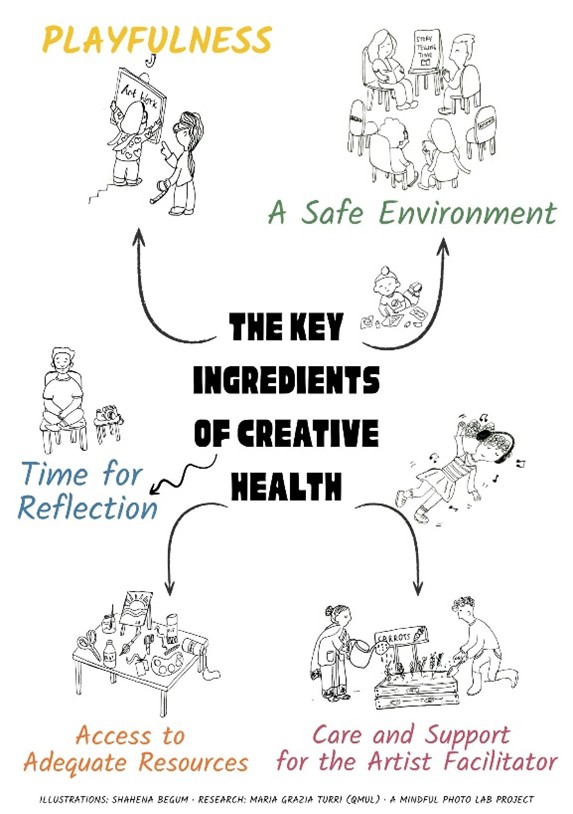
Supported by a grant from the Centre for Public Engagement at QMUL we explored the “key ingredients” of creative health with a group of artists who facilitate creative health activities within community settings. We engaged in creative workshops where the artists shared elements of their practice and discussed which key ingredients led to improved mental health and wellbeing for participants. Sessions were recorded and thematic analysis was conducted. The project and its results have been published in the book Creative Health: In Practice, which was distributed during the East London Festival of Creative Health in May 2026, organised by Mindful Photo Lab. The findings from the project also guided the festival exhibition and will be used as a tool to support artists practicing in creative health or intending to work in the field.
PIECEs: Improving community-based care of people living with psychosis in India and Pakistan
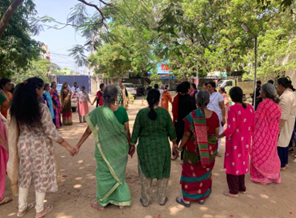
PIECEs was a four-year research programme aimed at improving community-based care for people living with psychosis in India and Pakistan. Funded by the NIHR, the programme explored how more collaborative, person-centred approaches can strengthen mental health care. At its heart was DIALOG+, a low-cost, app-based intervention designed to support better conversations between people with lived experience and clinicians. Led by QMUL, the Schizophrenia Research Foundation (SCARF) in Chennai, and Interactive Research and Development (IRD Global) in Karachi, PIECEs brought together researchers, people with lived experience, caregivers, artists, healthcare providers, and community leaders. Through approaches such as Theatre of the Oppressed, SALT, Quality Improvement, and Small-Scale Research Grants, the programme championed participatory practice and showed that people with lived experience are not just research participants, but co-creators, knowledge-holders, and agents of change.